Amazon Relay for Dispatchers and Carriers: What to Verify Before Booking
Amazon Relay is a carrier freight platform with its own eligibility, safety, insurance, equipment, driver, and booking requirements. A dispatcher can help an approved carrier organize searches, planning, and communication, but should verify current Relay rules directly before building a workflow around the platform.
Start with current carrier eligibility
As of September 30, 2026, Amazon Relay's FAQ states minimum requirements that include:
- a DOT number with interstate authority active for a minimum of 180 days to complete onboarding;
- a valid MC number;
- a carrier entity type authorized for property and for-hire;
- qualifying FMCSA safety status and BASIC thresholds;
- specified violation-rate thresholds;
- required insurance policies.
Relay also says carriers can apply before the 180-day DOT tenure is reached so the application can begin.
These are current first-party requirements, not permanent rules. Check the live Relay FAQ before onboarding a carrier.
Current insurance requirements matter
Relay's FAQ currently lists minimum insurance levels including:
- Commercial General Liability: at least $1,000,000 per occurrence and $2,000,000 aggregate;
- Auto Liability: at least $1,000,000 per occurrence;
- trailer replacement coverage: $50,000;
- cargo coverage: at least $100,000;
- workers' compensation in jurisdictions where required by the program;
- employer liability: at least $100,000 per occurrence.
Do not copy these numbers into a carrier agreement without confirming the current requirements and the carrier's actual policy.
Equipment and freight options
Amazon Relay describes freight for multiple truck and trailer types. Its public equipment page says approved carriers can find work through:
- spot loads;
- Post A Truck;
- contracts;
- auctions.
The exact equipment available and market opportunities change.
Relay also describes both power-only and trailer-required work. Power-only can involve pre-loaded Amazon trailers, while other loads may require the carrier's own trailer.
Amazon loads are not tendered through third-party boards
Amazon's current power-only page includes an explicit fraud warning: Amazon does not tender loads through third-party load boards. Loads are tendered directly to approved and onboarded carriers through the Relay web portal or app.
That is an important dispatcher control.
If someone claims to offer an “Amazon load” outside the approved workflow:
- stop;
- verify through the official Relay account;
- do not send carrier documents to an unverified party;
- follow the carrier's fraud procedure.
A high rate is not a reason to bypass identity controls.
What a dispatcher should verify before booking
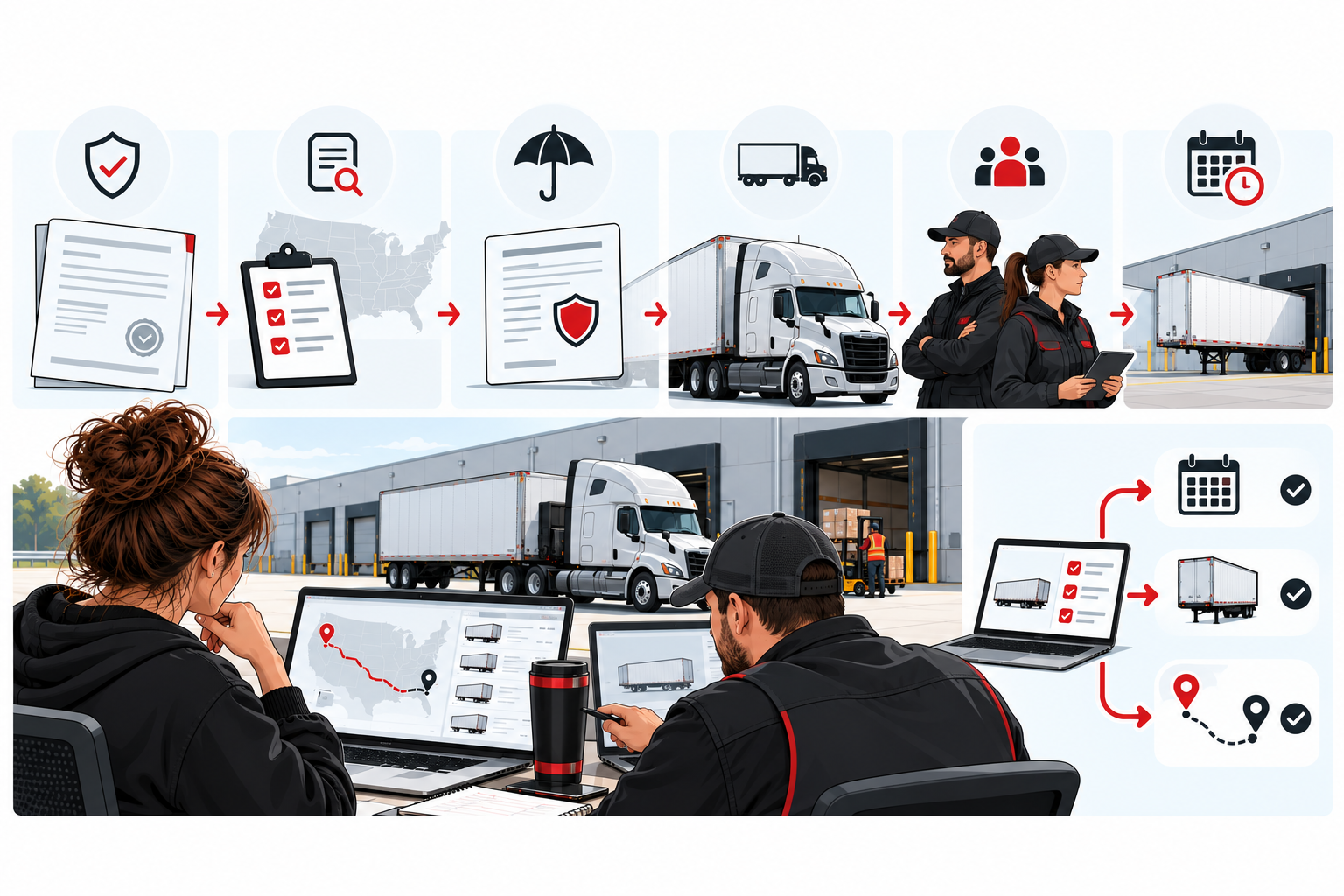
Use a consistent checklist.
Carrier
- Relay account active;
- authority and insurance current;
- correct carrier profile;
- approved drivers and equipment.
Truck and driver
- current location;
- equipment type;
- driver availability;
- HOS status reported through the carrier process;
- facility access requirements.
Load
- origin and destination;
- pickup / delivery timing;
- equipment;
- load type;
- distance;
- trailer workflow;
- rate shown at booking;
- next-market plan.
After booking
- driver dispatch message;
- trailer / facility details;
- check-in steps;
- trip updates;
- delivery / trailer return process;
- closeout.
Power-only workflow deserves separate planning
Relay describes thousands of pre-loaded trailers across its network for power-only freight. The dispatcher should still model:
- tractor deadhead to the trailer;
- whether the driver can meet the pickup;
- trailer handoff process;
- linehaul;
- trailer drop;
- tractor position after delivery.
Do not compare only the loaded segment.
Use current Relay data, not old YouTube earnings claims
Historical videos may mention peak-season gross revenue or single-truck monthly amounts. Those figures are not a reliable 2026 earnings forecast.
Rates vary by load, market, equipment, driver availability, and current program conditions. Relay's own public pages state that recent averages may be shown for some searches while live rates are provided at booking.
Use current booking information for decisions.
Frequently asked questions
Can a new authority join Amazon Relay immediately?
Relay currently says DOT interstate authority generally needs to be active for at least 180 days to complete onboarding, although carriers can apply earlier.
Do I need multiple trucks?
Relay's equipment page says there is no fleet-size minimum as long as the carrier meets requirements and has suitable equipment.
Can I book Amazon loads from DAT or Truckstop?
Amazon states it does not tender loads through third-party load boards. Approved carriers should book through Relay.
Is Relay a free load board?
Approved carriers can access Relay's booking tools as part of the platform. Eligibility, operating costs, insurance, and freight economics are separate issues.
Build the workflow around current rules
Use the power-only dispatching guide for trip logic and verify current requirements on the official Amazon Relay FAQ before operating.
Sources and further reference
- Amazon Relay — Frequently Asked Questions
- Amazon Relay — Power-only loads
- Amazon Relay — Truck requirements
Worked scenarios, comparisons, and checklists in this article are educational examples or editorial recommendations. They are not promises of employment, rates, revenue, or profit.
