How Long Does It Take to Learn Truck Dispatching?
There is no universal number of days required to “learn truck dispatching.” Course runtime, practice time, supervised work, and independent readiness are different measures. A better plan is to use milestones: can you explain a shipment, evaluate loads, communicate terms, organize documents, handle a delay, and complete a handoff without losing critical information?

Course runtime is not job readiness
A course may contain ten hours, twenty hours, or many more hours of material. That tells you how long the lessons are, not how long a beginner needs to build reliable operating habits.
The current Trucking Territory site describes a program with 56 lessons, approximately 10 hours of material, practical assignments, and lifetime access. Those are product-format facts. They should not be interpreted as a ten-hour path to independent professional competence.
Likewise, a statement such as “learn in two months” only becomes useful when the expected skills and amount of practice are defined.
Stage 1: understand the shipment workflow
A beginner should be able to explain:
- who the carrier, driver, broker, shipper, and receiver are;
- what happens before a load is booked;
- what a rate confirmation does;
- where the bill of lading and proof of delivery enter the process;
- why equipment, appointments, and driver availability matter.
This stage can move quickly for someone with logistics or operations experience and more slowly for someone who is learning U.S. trucking vocabulary at the same time.
Milestone: explain one fictional shipment from truck availability through document closeout without reading a script.
Stage 2: evaluate loads consistently
Build a fictional truck profile. Then compare at least three loads against the same constraints.
| Question | Evidence you can produce |
|---|---|
| Equipment fit | Written reason a load does or does not fit |
| Pickup feasibility | Arrival calculation plus uncertainty |
| Destination | Carrier preference or next-market reasoning |
| Economics | Loaded and all-in miles calculated consistently |
| Broker | Verification steps recorded |
| Approval | Clear statement of who must approve |
Do not advance simply because you can identify the highest posted rate. The skill is explaining why the load is workable for this truck.
Stage 3: communicate and document decisions
Practice broker calls, driver updates, and written summaries. Use invented information and mark the exercise as a simulation.
A strong milestone is to convert a five-minute role-play call into a short written record containing the shipment, agreed facts, unresolved issues, and next action.
Then build a fictional shipment folder. Another person should be able to identify the current RC, pickup document, updates, and closeout record.
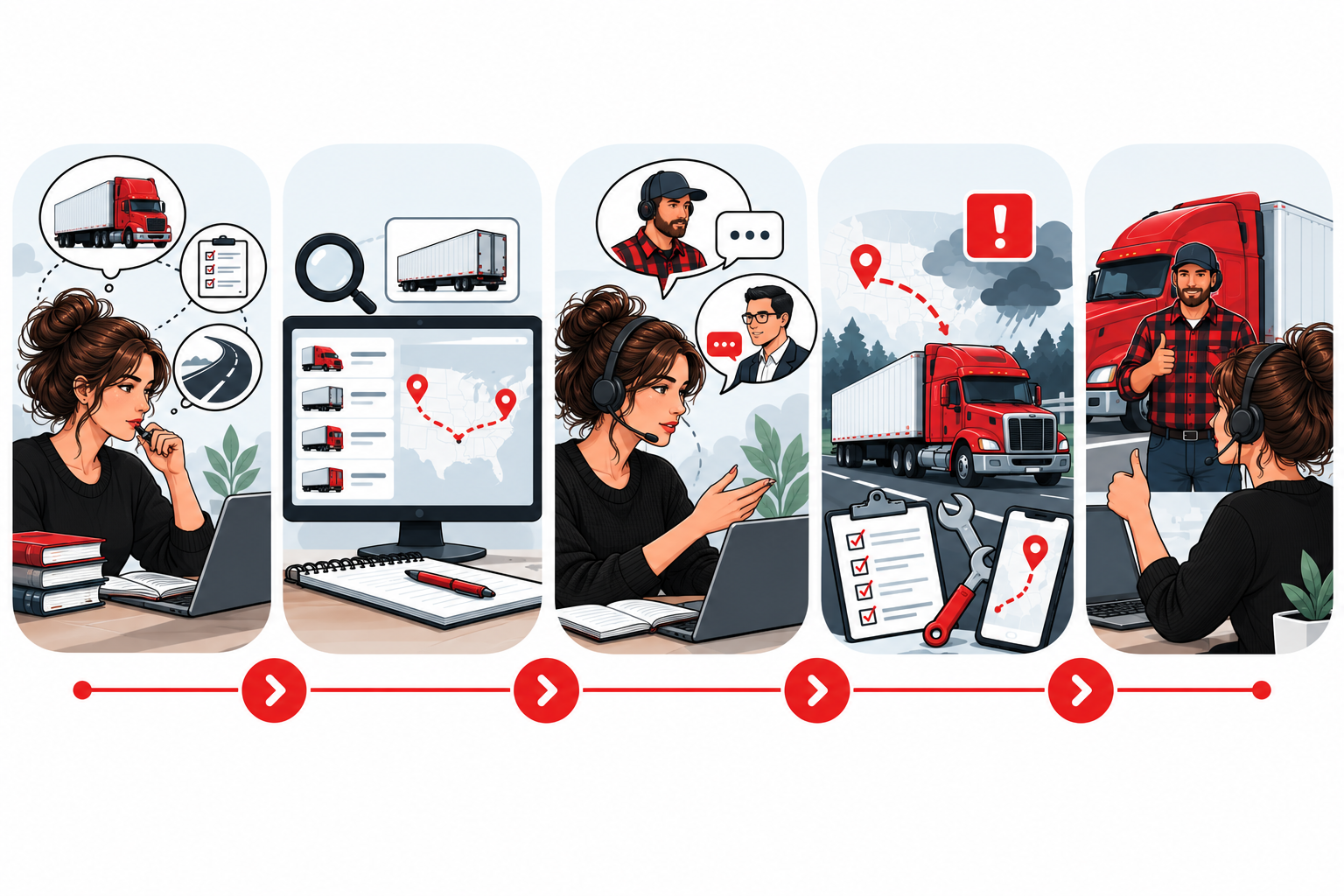
Stage 4: introduce exceptions
Normal examples are useful, but exceptions show whether you understand the workflow.
Change one variable at a time:
- pickup is delayed;
- commodity details differ from the original posting;
- delivery appointment changes;
- driver-reported availability is lower than expected;
- POD is unreadable;
- someone asks to change payment instructions.
The correct response is not always “solve it yourself.” A dispatcher also needs to know when to pause and escalate to the carrier, driver, safety contact, broker, or another responsible person.
Three example learning schedules
These are planning structures, not promises.
Four-week intensive structure
Suitable only when the learner has significant daily study time and quick access to feedback.
- Week 1: vocabulary and shipment workflow.
- Week 2: load search and economics.
- Week 3: communication, documents, and booking simulations.
- Week 4: exception scenarios and integrated cases.
The learner may still need supervised practice after finishing the schedule.
Eight-week balanced structure
A more realistic format for someone combining training with other responsibilities.
- Weeks 1–2: foundations and terminology.
- Weeks 3–4: load evaluation and load-board practice.
- Weeks 5–6: broker calls, driver communication, documents.
- Weeks 7–8: exceptions, full-day simulations, review.
Twelve-week lower-intensity structure
Useful when English, industry vocabulary, or available study time makes a slower pace more practical.
The content does not need to be different; the repetition and feedback cycle is longer.
What changes the timeline?
Prior experience matters. Customer service can help with communication. Sales can help with calls. Logistics or fleet operations can shorten the learning curve for documents and timing. Strong spreadsheet skills can make calculations easier.
But transferable skills do not automatically cover freight-specific responsibilities. A good learner identifies what carries over and what still needs explicit practice.
English proficiency can also affect the timeline because phone calls involve accents, noisy environments, addresses, commodity names, and rapid clarification. Practice real-world listening conditions rather than only polished lesson audio.
A readiness test is more useful than a calendar
Before describing yourself as ready for independent work, complete a portfolio that includes:
- one complete truck profile;
- a comparison of three loads;
- a broker-call summary;
- a reviewed rate confirmation exercise;
- a delay / exception log;
- a complete document folder;
- a shift handoff.
Passing your own checklist does not create a professional certification. It gives a supervisor, mentor, or employer something concrete to review.
Frequently asked questions
Can I become a dispatcher in one month?
You can learn substantial material in a month, especially with prior experience and daily practice. The calendar alone cannot establish readiness. Use task-based milestones.
Do I need to finish every lesson before practicing?
No. Practice should begin early with fictional examples. For example, after learning load basics, compare sample loads before moving to later modules.
When can I start applying for jobs?
You can research roles while training. In applications, describe your actual level honestly: training completed, simulations performed, tools studied, and any transferable experience. Do not present simulated work as employment history.
Use training time to build evidence
The how-to-become-a-dispatcher roadmap explains the sequence, while the skills guide gives measurable practice targets. If you use the Trucking Territory course, treat its lessons as inputs to that practice plan rather than a guaranteed completion date.
Sources and further reference
- O*NET — Dispatchers, Except Police, Fire, and Ambulance (43-5032.00)
- DAT — How to Become a Truck Dispatcher
- Trucking Territory — Course page
Worked scenarios, comparisons, and checklists in this article are educational examples or editorial recommendations. They are not promises of employment, rates, revenue, or profit.
