How to Become a Truck Dispatcher With No Experience
To become a truck dispatcher with no experience, learn the shipment workflow, practice evaluating loads, and demonstrate that you can communicate and document decisions accurately. Then pursue an employee role or build a properly reviewed independent-service model. Completing lessons is a starting point; handling a realistic assignment is a better readiness test.

Decide which starting path you are pursuing
An entry-level employee path and an independent-business path require different preparation. An employer may provide systems, supervision, and an existing carrier operation. An independent service must also acquire clients, define its scope, control expenses, and establish appropriate agreements.
Do not choose self-employment solely because a course advertisement suggests that experience is unnecessary. You are taking on additional business work, not removing the operational learning requirement. DAT's introductory guide distinguishes employment from starting a dispatching business; use that distinction to keep your plan focused.
Phase 1: learn the vocabulary through a shipment
Instead of memorizing a long glossary, follow one fictional shipment from search to delivery. Identify the carrier, broker, shipper, receiver, truck, trailer, and driver. Mark where the pickup appointment, delivery appointment, rate confirmation, bill of lading, and delivery evidence enter the process.
At the end of this phase, explain the shipment to another person in plain English. When you cannot explain a document or decision, return to that specific topic. You do not need to sound impressive; you need to be unambiguous.
Phase 2: learn to reject unsuitable loads
Create a truck profile with equipment details, availability, destination preferences, and carrier-approved commercial limits. Compare three training loads against the profile.
Use a two-pass process. First reject options with unresolved equipment, identity, timing, or safety issues. Then compare the economics of the remaining options. A high payment does not repair an impossible pickup appointment.
Your exercise should show the reason for each rejection. “Not a good load” is not enough. “Pickup is earlier than our estimated safe arrival” is an operational explanation that another person can review.
Phase 3: practice documents and communication
Prepare a fictional booking summary with shipment reference, confirmed contacts, equipment, addresses, appointment dates and time zones, agreed rate, and outstanding questions. Label every document “training example” and use invented information.
Next, rehearse a broker call. Ask for the shipment details before negotiating. Repeat the proposed terms and request written confirmation. Practice saying, “I need carrier approval before I can confirm,” rather than making a commitment you cannot authorize.
For a useful writing exercise, turn a five-minute simulated phone call into a five-line update. The reader should immediately understand the current status and next action.
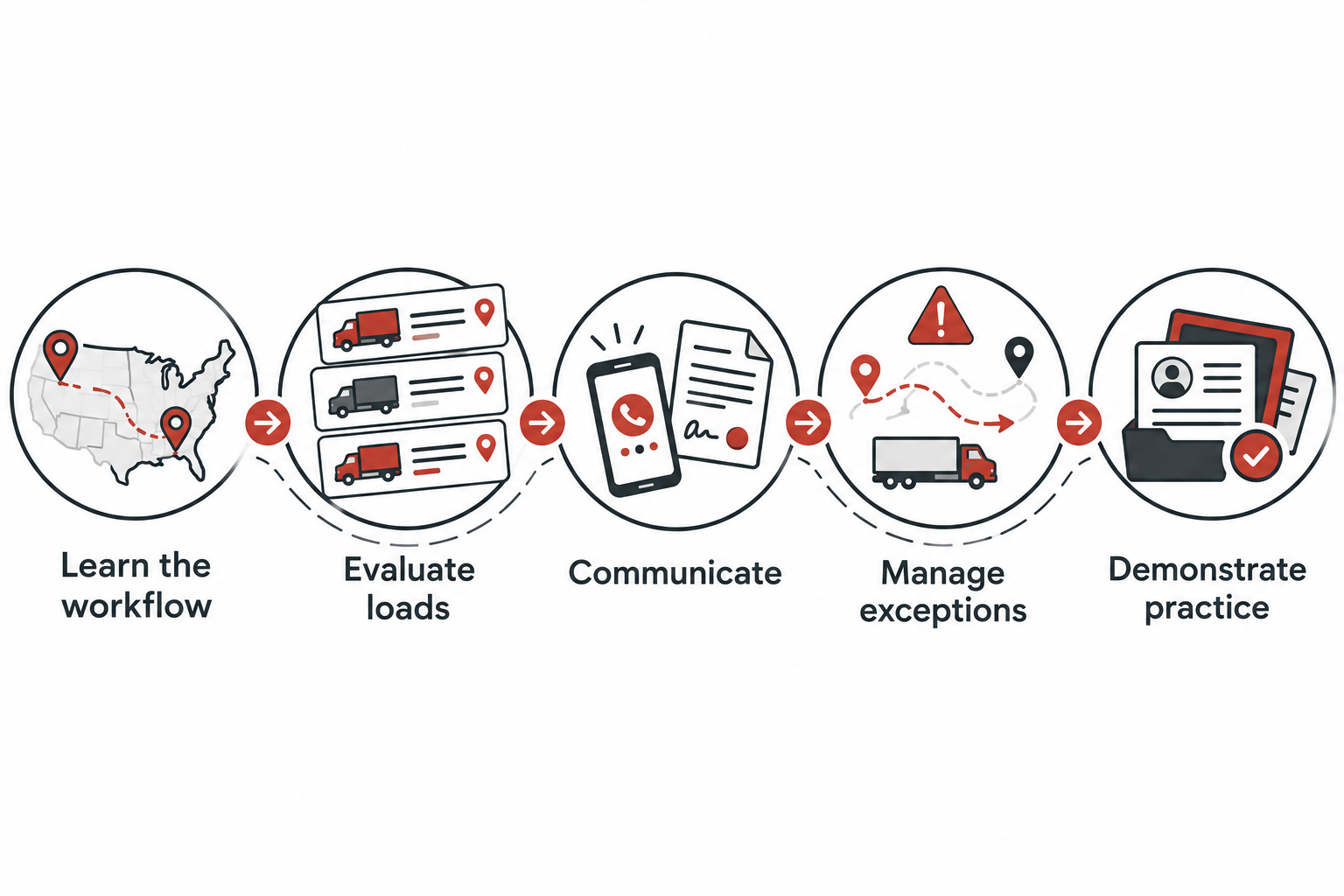
Phase 4: introduce problems into the exercise
The original load is only half the test. Add a delayed release, a different commodity, an unreadable delivery document, and a request to change payment instructions. Decide which problems you can resolve and which must be escalated.
Use FMCSA's hours-of-service summary as a reference during timing exercises, while leaving real-time compliance confirmation to the carrier and driver. Do not practice by guessing what an electronic logging device would show.
A useful practice portfolio contains one load-comparison sheet, one trip brief, one exception log, and one closeout checklist. Keep it anonymous and honest about its simulated nature.
Phase 5: apply for a role or prepare a controlled launch
For employment applications, describe the tasks you have practiced rather than calling yourself an experienced dispatcher. Show how you check details, communicate uncertainty, and organize records. Ask about supervision, working hours, equipment types, and escalation procedures.
For independent work, complete the business-startup checklist before accepting responsibility for a live truck. Training and client acquisition are not interchangeable. A signed client without a workable service process creates risk rather than proof that the business is ready.
A practical readiness check
| Test | Evidence of readiness |
|---|---|
| Explain one shipment | Correct parties, documents, and sequence |
| Evaluate three loads | Clear rejection reasons and consistent calculations |
| Summarize a call | Accurate written terms and unresolved questions |
| Handle a delay | Revised plan with owner and next update |
| Close the exercise | Complete, clearly named document folder |
Passing this checklist does not certify professional competence. It tells you where additional guided practice is needed before taking on live responsibility.
Frequently asked questions
How long does learning take?
There is no universal timeline. Measure progress through practical tasks and feedback rather than the number of videos completed. A course's runtime is not the same as time to independent proficiency.
Do I need to buy every dispatching tool immediately?
No. Begin with exercises and verify product eligibility before subscribing. The starter tool-stack guide separates essential functions from optional software.
Can a certificate guarantee a job?
No. Evaluate a certificate as evidence of completing a specific program, not a guarantee of employment, legal authorization, or practical competence.
Choose your next learning task
Review Trucking Territory's training alongside this roadmap. Start with the weakest skill in your readiness check and practice it until you can explain your decisions without relying on a memorized script.
Sources and further reference
- DAT — Start Up Guide: How to Become a Truck Dispatcher
- FMCSA — Summary of Hours of Service Regulations
Worked scenarios and checklists in this article are educational examples or editorial recommendations, not promised business results.
