Deadhead Miles in Trucking: Plan the Whole Trip, Not One Load
Deadhead miles are miles traveled without a paying load. They matter because the truck still uses time and operating resources while moving empty. Good dispatch planning does not aim for zero deadhead at any cost; it compares the entire trip, including realistic options after delivery.

Separate necessary movement from avoidable movement
An empty approach to pickup may be necessary to reach a suitable load. A planned reposition may be sensible if it creates a better operating position. Other empty movement can result from weak planning, stale availability information, or a booking that ignored the next destination.
Use a reason code for each empty segment. This helps the carrier distinguish a deliberate tradeoff from an error. A single weekly deadhead percentage cannot explain why the movement occurred.
The useful question is: “What would the truck do instead, and what are the costs and constraints of that alternative?” Compare an empty move with a real alternative, not an imaginary perfect load that may not be available.
Calculate the empty-mile share consistently
Empty-mile share = empty miles ÷ total miles × 100.
If a planning period contains 300 empty miles and 1,700 loaded miles, the total is 2,000 miles and the empty-mile share is 15%. This is a hypothetical example, not a recommended target.
Use the same route and measurement method across periods. A change in how you record miles can look like an operational improvement even when the truck's actual movement has not changed.
Compare a round-trip plan with an empty-return case
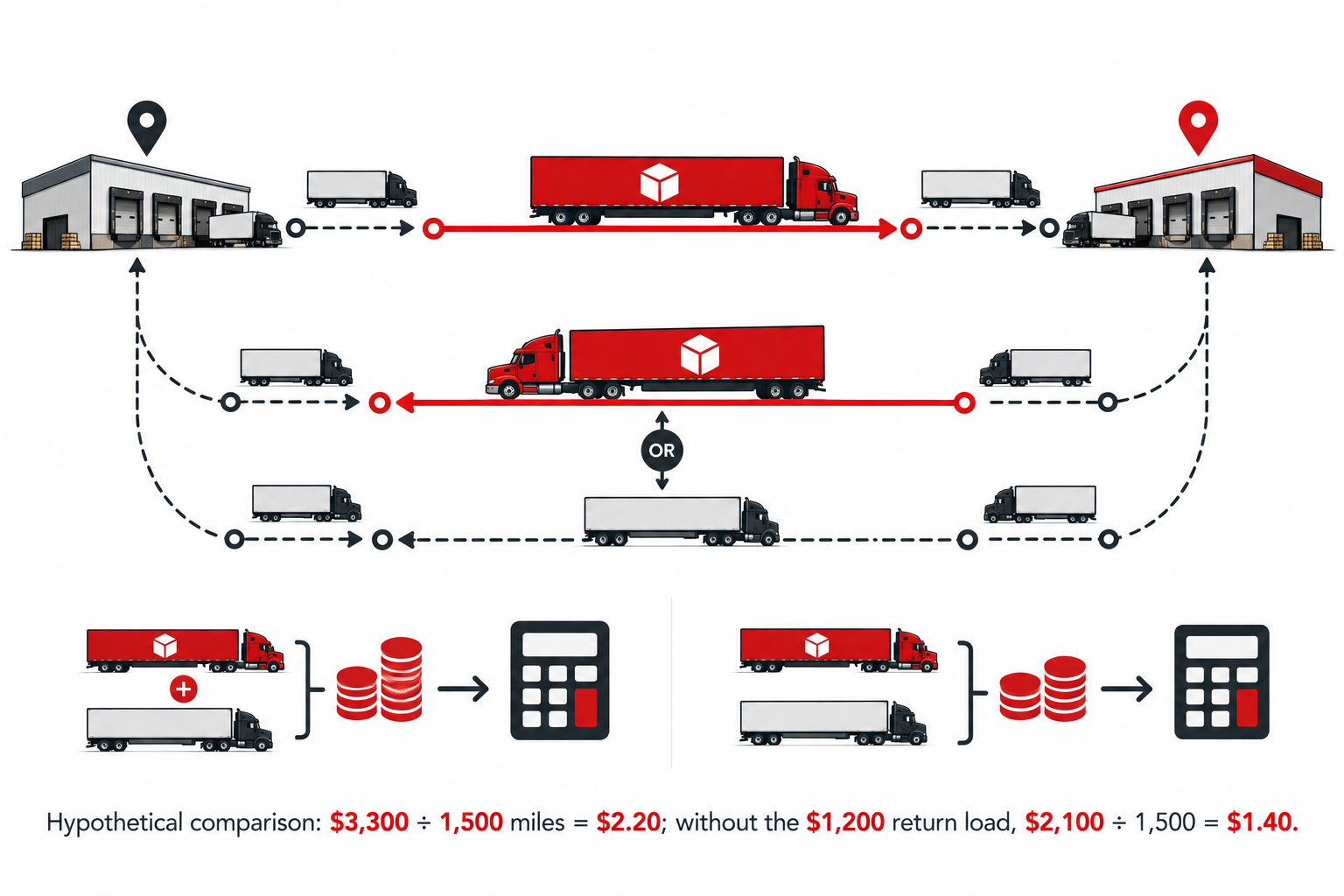
Suppose a fictional plan includes 700 outbound loaded miles for $2,100, 600 return loaded miles for $1,200, and 200 empty miles across the two legs. The combined calculation is:
($2,100 + $1,200) ÷ (700 + 600 + 200) = $2.20 per total mile.
Now test a different scenario: the return load is not obtained and the truck travels the same 600-mile return segment empty. Revenue becomes $2,100 while total miles remain 1,500, producing $1.40 per total mile.
The point is not that a return load is guaranteed or that these figures represent a real lane. The point is that an unconfirmed next load should not be silently built into the expected result as if it were already booked.
Treat waiting as an alternative with a cost
If no suitable return load is available, the options may include waiting, repositioning, or taking another feasible route. Compare the truck time, likely operating expenses, driver requirements, and uncertainty associated with each option.
Do not assign a precise probability to finding tomorrow's load without a defensible basis. Use explicit scenarios instead: suitable freight becomes available, only a less attractive option appears, or no acceptable load is found during the review period.
For each scenario, show what decision would follow. That creates a contingency plan rather than a prediction disguised as a spreadsheet.
Use search tools to investigate the next position
Before approving an outbound option, inspect the likely delivery area and timing using the carrier's authorized tools. Truckstop's load-board product information includes backhaul and route-related features in its published comparison; verify the tools available in the actual plan.
A search result is not a reservation. Confirm the next shipment through the normal approval and documentation process when the timing and other requirements are workable. Do not book a tight sequence based on an optimistic unloading estimate alone.
Keep safety and truck suitability as hard constraints
A lower empty-mile share is not a good result if it requires unsuitable cargo, an impossible appointment, or pressure to operate beyond the actual limits. Compare only options that the carrier and driver can perform appropriately.
When a plan changes, revise the full sequence. A delay on the first leg can invalidate the next pickup even if the original mileage arithmetic remains correct. Time dependencies deserve the same attention as distance.
Review deadhead without punishing necessary decisions
In a weekly review, show total miles, empty miles, reasons, trip duration, and relevant revenue together. Discuss which empty segments were planned, which arose from exceptions, and which might be avoided through a process change.
Do not evaluate a dispatcher on deadhead percentage alone. A metric that rewards any loaded movement can encourage accepting freight that is commercially or operationally unsuitable.
Frequently asked questions
Is every empty mile bad?
No. Some empty movement can support a better whole-trip decision. It still needs to be included in the mileage and cost model.
Can a high outbound rate justify a weak return position?
Possibly, but test the downside case explicitly. The decision should remain understandable if the hoped-for return load is unavailable.
Should I average the rates of the outbound and return loads?
Use combined revenue divided by combined corresponding miles. A simple average of load-level rates can misrepresent the whole trip.
Build the next position into your review
Use the all-mile rate calculation and load-search checklist together. Explore Trucking Territory's course to practice comparing the full operating sequence rather than one attractive posting.
Sources and further reference
Worked scenarios and checklists in this article are educational examples or editorial recommendations, not promised business results.
