How to Calculate Rate Per Mile Without Ignoring Empty Miles
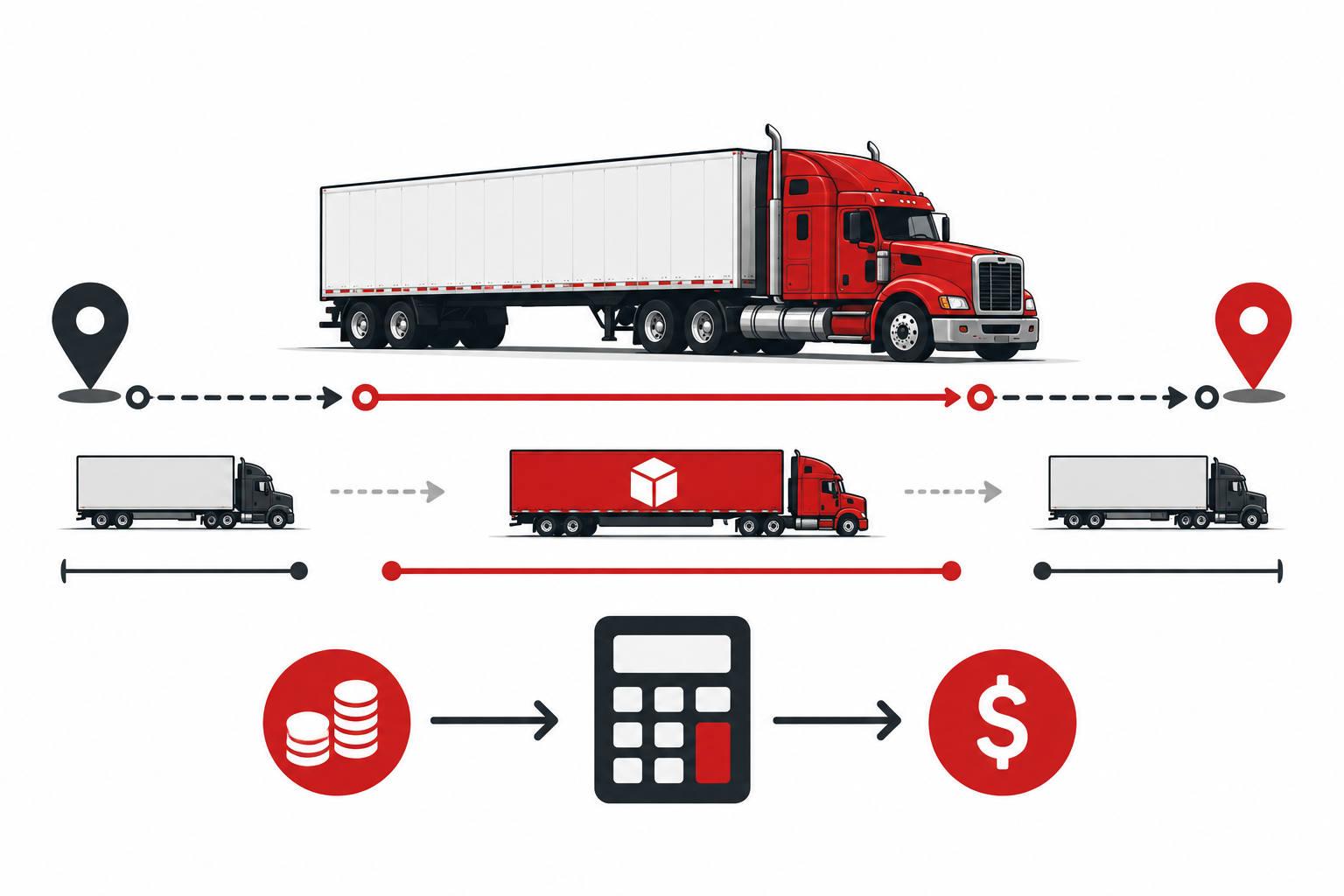
Rate per mile is revenue divided by a defined mileage total. A loaded-mile rate uses only miles traveled with the shipment. An all-mile rate includes the empty miles assigned to the trip. Neither number is profit until you compare it with a complete, consistently defined cost model.

Start by defining both inputs
Write down which revenue components are included. Are you comparing linehaul only, linehaul plus fuel, or the total agreed amount? Keep approved extra charges separate from charges that have only been requested.
Then define the mileage basis. Include the route the carrier plans to use, not just a convenient straight-line distance. Explain whether your trip includes only empty miles to pickup or also a planned repositioning movement after delivery.
A number labeled “RPM” without those definitions is easy to misunderstand. When using rate information from a load-board product, inspect the product's definitions before comparing it with your own calculation.
The two basic formulas
Loaded RPM = included shipment revenue ÷ loaded miles
All-mile RPM = included shipment revenue ÷ total assigned miles
Total assigned miles = loaded miles + assigned empty miles
If the mileage denominator is zero or missing, do not report a normal RPM value. Mark the calculation as unavailable and resolve the input. A spreadsheet that silently converts missing distance to zero can produce a misleading result.
A complete hypothetical example
Assume a shipment pays $1,800 under the revenue definition used in this exercise. The truck travels 600 loaded miles, 100 empty miles to pickup, and 50 additional empty miles assigned to the trip after delivery.
| Item | Calculation | Result |
|---|---|---|
| Loaded miles | Given input | 600 |
| Assigned empty miles | 100 + 50 | 150 |
| Total assigned miles | 600 + 150 | 750 |
| Loaded RPM | $1,800 ÷ 600 | $3.00 |
| All-mile RPM | $1,800 ÷ 750 | $2.40 |
| Empty-mile share | 150 ÷ 750 | 20% |
The same shipment can be described as $3.00 per loaded mile and $2.40 per total mile. Neither calculation is wrong when labeled correctly. The mistake is using the first number while pretending that the empty movement has no effect.
Add a defined cost model
Suppose, for this illustration only, the carrier's allocated cost model is $1.85 per total mile and already includes the expense categories the carrier intends to allocate. Then the modeled trip cost is 750 × $1.85 = $1,387.50. The difference between the example revenue and modeled cost is $412.50.
That difference is a planning result under invented assumptions, not a market benchmark or a claim about accounting net profit. Missing expenses, changed mileage, unpaid charges, or a different allocation method will change the outcome.
Do not add the same cost twice. If the $1.85 already includes an allocation for a fixed expense, adding that expense again overstates cost. Conversely, a fuel-only cost estimate is not a complete operating-cost model. Agree on the definitions with the carrier and its accounting support.
Consider time as well as miles
Two shipments can have the same all-mile RPM and different operating value because one ties up the truck longer. Record expected trip duration, appointment constraints, and uncertainty about release times.
For a decision sheet, show the payment, total miles, modeled cost, and truck time side by side. Avoid compressing every tradeoff into one score. If a key assumption is uncertain, test an alternative scenario instead of hiding the uncertainty in an average.
Keep a consistent weekly view
For a period-level all-mile rate, divide total included revenue by total corresponding miles. Do not take a simple average of individual load RPM values when the mileage differs; that gives a short load the same weight as a long one.
For example, $500 over 100 miles and $1,500 over 900 miles produce $2,000 over 1,000 miles, or $2.00 per mile overall. Averaging $5.00 and about $1.67 would produce about $3.33, which does not describe the combined mileage.
Frequently asked questions
What is a good rate per mile?
There is no universal profitable number. It depends on the carrier's equipment, costs, mileage, time commitment, and current opportunity set. Use the carrier's defined model rather than a generic threshold.
Should I include an expected detention payment?
Keep unapproved charges out of confirmed revenue. You can model a clearly labeled scenario separately, but do not treat a possible payment as collected income.
Is all-mile RPM enough to choose a load?
No. It is one useful measure. Equipment fit, timing, identity checks, carrier instructions, risk, and the next position also matter.
Make the calculation auditable
Use the load-search process to collect consistent inputs and the deadhead guide to define empty movement. Explore Trucking Territory's training to practice explaining the decision behind the number.
Sources and further reference
Worked scenarios and checklists in this article are educational examples or editorial recommendations, not promised business results.
