How to Find Loads for Trucks: A Step-by-Step Search Process
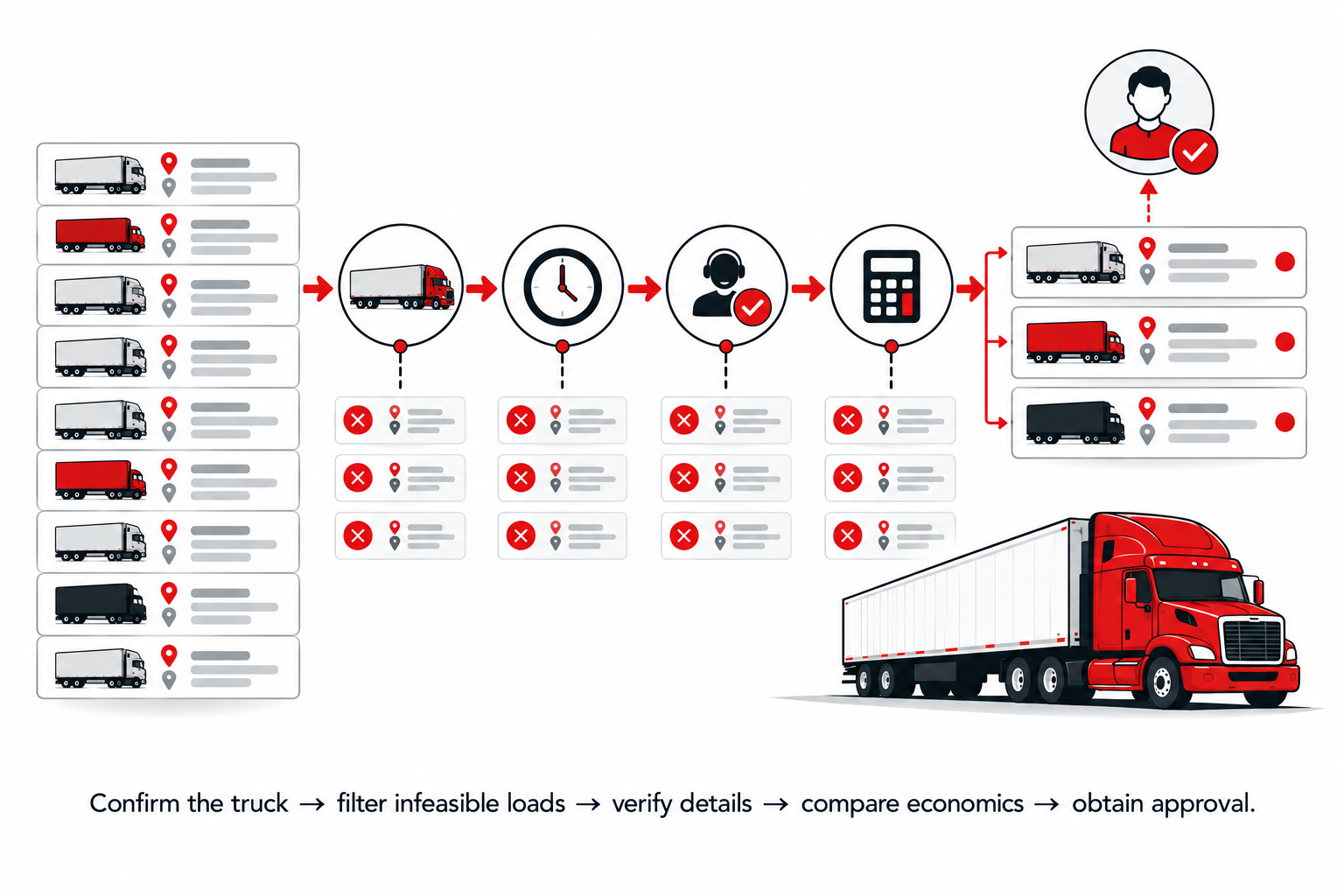
To find a suitable load, start with the truck's actual constraints, not an empty search box. Confirm availability and equipment, define the search, reject infeasible options, verify shipment details, compare the whole-trip economics, and obtain the required carrier approval before committing.

Create a live truck profile
Record the truck's current location, expected empty time, equipment details, driver-reported availability, destination preferences, and carrier instructions. Include who supplied each time-sensitive fact and when it was last confirmed.
A profile from yesterday may no longer be usable today. An unloading delay, equipment problem, changed home-time requirement, or different legal availability can alter the search before you make the first call.
Keep commercial preferences separate from hard constraints. A preferred destination may be negotiable. Equipment incompatibility or an unworkable legal schedule is not fixed by a higher offered rate.
Build a focused initial search
Choose an origin radius, pickup period, equipment type, and destination approach that fit the profile. Start with a manageable set of options and expand only when you know why the original search is insufficient.
DAT and Truckstop offer load-search products, but confirm the features and access available under the actual account. A posted result is a lead to investigate, not a confirmed shipment or a promise that the carrier qualifies to haul it.
Record which changes you make to the search. Expanding the radius can add deadhead. Moving the pickup date can add idle time. Those are economic changes, not merely ways to make the result count look better.
Apply hard filters before rate comparisons
Reject or pause options with unresolved equipment requirements, unrealistic timing, unacceptable cargo conditions, or identity concerns. Do not spend negotiation time on a load that the carrier cannot perform under its actual constraints.
Use a short rejection code in your working sheet. Examples include equipment mismatch, pickup timing, destination restriction, missing detail, counterparty review, and economics. A clear log makes it easier to explain why the search is difficult and where a genuine adjustment might help.
Call for the missing operational details
Confirm pickup and delivery addresses, dates, appointment windows, time zones, commodity, weight, dimensions, loading method, equipment requirements, and special instructions as applicable. Ask whether the shipment is still available and which terms need written confirmation.
Do not substitute assumptions for missing information. “Standard dry van” does not answer every question about cargo, loading, clearance, or site access. Refer uncertain technical requirements to the carrier before treating the load as a match.
Compare shortlisted loads consistently
Use the same mileage and cost definitions for every option. Include empty movement to pickup and other reasonably planned repositioning. Record the expected time commitment and what is known about the next position after delivery.
Here is a simplified hypothetical comparison that ignores other costs to isolate mileage:
| Option | Revenue | Loaded miles | Empty miles to pickup | Revenue per total mile |
|---|---|---|---|---|
| A | $1,800 | 600 | 120 | $2.50 |
| B | $1,700 | 600 | 20 | $2.74 |
Option A pays more in total. Option B produces more revenue per mile under these assumptions. Neither is automatically the better booking: timing, total trip cost, carrier preferences, counterparty review, and destination options still need evaluation.
Confirm the approved choice in writing
Present the shortlist and recommendation in a format the carrier can review. Identify open questions and the assumptions behind the calculation. Obtain approval through the agreed process.
Then compare the received rate confirmation with the terms discussed. If the document changes a material detail, resolve the difference before treating the booking as complete. Use the rate-confirmation checklist rather than relying on memory from the call.
Save useful search intelligence
Record why the accepted load was selected and what happened afterward. Over time, this creates a carrier-specific history of appointment reliability, communication issues, document problems, and lane outcomes.
Do not confuse that history with a universal market forecast. Use it to improve your own process while checking the current facts for each new shipment.
Frequently asked questions
Should I always sort by the highest rate?
No. First establish feasibility, then compare economics on a consistent basis. A high advertised payment can hide empty miles, long waits, or requirements the truck cannot meet.
What if no suitable loads appear?
Explain the limiting factors to the carrier. Discuss changes to timing, radius, or destination preferences without quietly abandoning hard constraints or making unsupported commitments.
Can I book a return load before the first one is complete?
Only proceed through the carrier's approved process with a realistic plan and clear dependencies. Do not treat an uncertain release time as a confirmed availability.
Practice the decision, not just the search
Use the rate-per-mile guide and deadhead planning guide to evaluate the shortlist. Explore Trucking Territory's course for structured learning around the shipment workflow.
Sources and further reference
Worked scenarios and checklists in this article are educational examples or editorial recommendations, not promised business results.
