Detention, Layover, and TONU: Document the Event Before the Claim
Detention generally concerns loading or unloading delay beyond the applicable free time. Layover commonly describes a longer disruption that holds the truck over. TONU means “truck ordered not used.” Whether a charge is payable, its amount, and the required evidence depend on the actual agreement and circumstances—not a universal rate copied from a blog.

Start with the event and the agreement
The FedEx glossary describes detention as a charge when a truck is held beyond allotted free time. Diversified Transportation Services explains TONU in the context of a truck ordered for work that cannot proceed. Those descriptions help with terminology; they do not establish the terms for your shipment.
Before pickup, review the conditions that apply to additional charges. Identify the notice procedure, supporting documents, approval contact, time calculation, and submission deadline in the actual agreement. Do not assume that a commonly discussed two-hour free-time rule applies to every load.
Distinguish the categories without forcing the facts
| Situation | Working description | What to verify |
|---|---|---|
| Loading or unloading delay | Possible detention | When chargeable time begins and what evidence is required |
| Extended disruption | Possible layover | Whether the agreement defines and compensates the event |
| Ordered truck not used | Possible TONU | Cancellation conditions, readiness, notice, and approval |
| Other additional service | Possible accessorial | Whether the service was requested, authorized, and documented |
Use the category that fits the facts and agreement. Do not rename the same delay in several ways simply to increase the amount requested.
Keep a contemporaneous event log
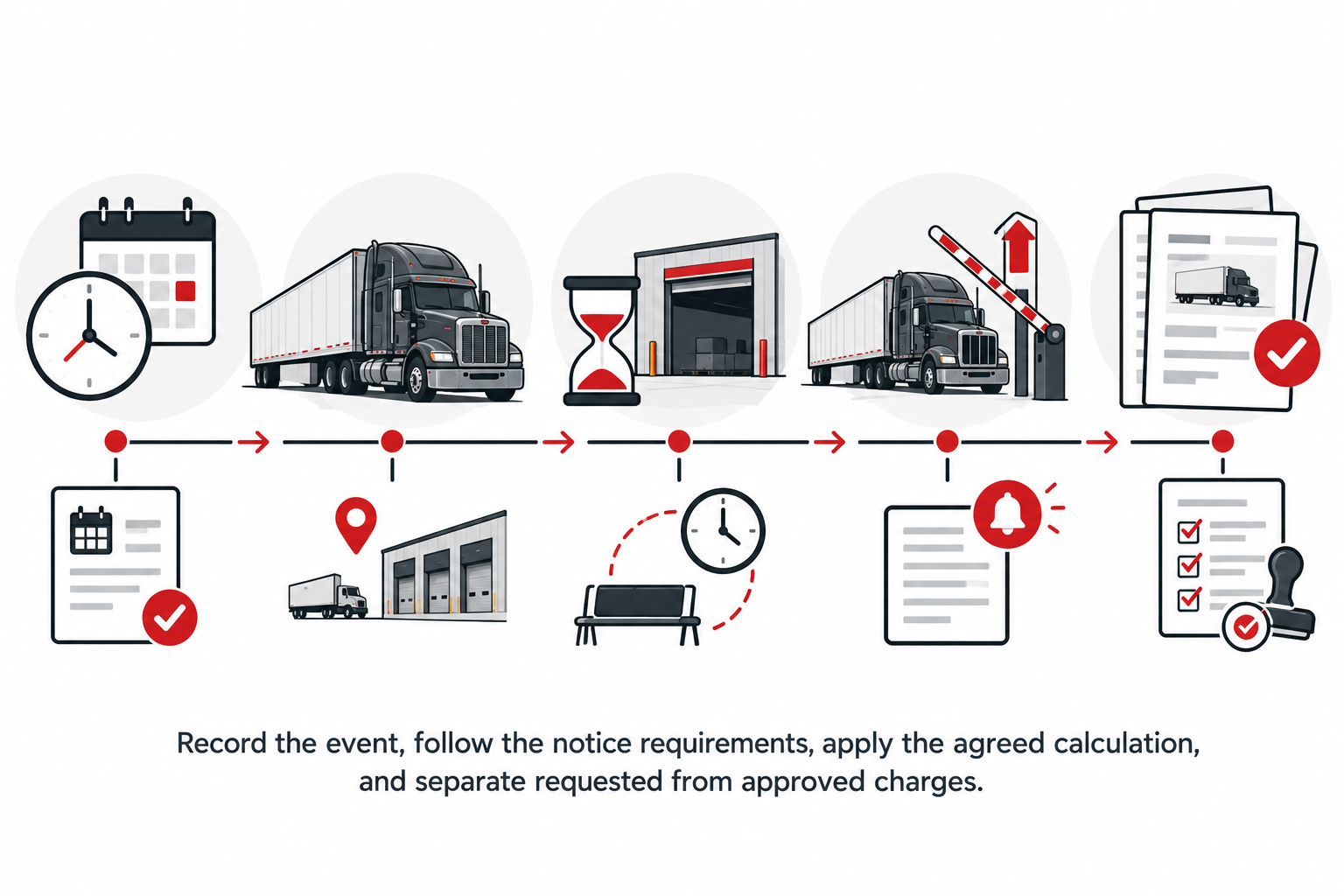
Record the scheduled appointment, actual arrival or check-in, relevant timestamps, release time, people contacted, and instructions received. Include the local time zone. Preserve the original evidence and identify who supplied each fact.
A log should make the timeline understandable without adding certainty you do not have. If a timestamp is an estimate, label it as an estimate and seek better evidence where possible.
Your records should also show whether the driver and equipment were ready under the agreed conditions. An arrival timestamp alone may not answer every eligibility question.
Notify through the required channel
Follow the agreed notice procedure promptly. Do not wait until invoicing to reveal a delay that required notice while the event was happening. Keep the message factual and avoid promising that payment is already approved.
A fictional notification could read:
Training shipment TT-208: the truck checked in at 09:00 local time and remains on site. We are documenting the delay and reviewing the applicable detention terms. Please confirm the required approval contact and any additional documentation needed.
For live use, replace the training details with verified information and follow the carrier's authority-to-act limits. This is a communication example, not a legal demand or a guaranteed entitlement.
Calculate only under the applicable terms
Consider a hypothetical agreement allowing two hours of free time after a qualifying appointment and paying $50 for each subsequent complete hour. Suppose qualifying time runs from 09:00 to 14:00 and all eligibility conditions are satisfied. Five hours less two free hours leaves three chargeable hours: 3 × $50 = $150.
Every part of that example is conditional. A different start rule, rounding method, cap, notice requirement, or agreement can change the result. The example is not an industry-wide rate or a statement that a particular broker must pay it.
Track requested, approved, and collected separately
Create separate fields for the amount requested, amount approved, supporting record, invoice status, and collection status. If only part of a request is approved, keep the difference visible and assign a follow-up owner.
Do not silently add an unapproved amount to confirmed trip revenue. Conversely, do not delete a documented request because the initial response is delayed. Follow the carrier's dispute and escalation procedure with the evidence preserved.
Review the operational impact as well as the charge
A delay can affect the next appointment, legal availability, parking plan, and return options. Revise the operating plan with the carrier and driver instead of treating the event only as a billing opportunity.
An approved payment does not automatically make the disruption commercially harmless. Record the truck time and downstream effects so future load decisions can use the complete history.
Frequently asked questions
Is detention always paid after two hours?
No. Confirm the actual free time, start conditions, notice rules, documentation, and approval requirements for the shipment.
Can I claim detention and layover for the same event?
Do not assume that both apply or can be combined. Review the agreement and obtain appropriate clarification through the carrier's process.
Does a cancellation automatically produce TONU payment?
No automatic payment is promised here. Eligibility depends on the agreed terms and facts of the cancellation.
Preserve the facts while solving the delay
Use the rate-confirmation review before the trip and the document-closeout guide afterward. Explore Trucking Territory's course to practice the full exception-management workflow.
Sources and further reference
- FedEx — Shipping Terms and Definitions (BOL and detention entries)
- Diversified Transportation Services — What Is TONU in Trucking?
Worked scenarios and checklists in this article are educational examples or editorial recommendations, not promised business results.
