Bill of Lading vs. Proof of Delivery: Keep the Documents Straight
A bill of lading, or BOL, records shipment information and the receipt or carriage of the freight. Proof of delivery, or POD, documents the delivery event. A signed delivery copy of a BOL may serve as POD in a particular workflow, but you should confirm what the carrier and billing recipient actually require.

Separate the purpose of each document
The FedEx shipping glossary describes a BOL as containing shipment details and serving receipt and carriage-related functions. Its examples are service-specific; do not assume that every trucking shipment uses the same form or terms.
For dispatch operations, organize documents by the question they answer:
| Document | Primary operational question |
|---|---|
| Rate confirmation | What shipment terms and payment were agreed? |
| Bill of lading | What freight was received for the shipment? |
| Proof of delivery | What evidence documents the delivery event? |
| Invoice | What amount is being billed, by whom, and under which references? |
| Supporting records | What evidence supports a change, extra charge, or exception? |
One document may support more than one function, but that does not make all the documents interchangeable. Confirm the actual closeout requirements before the load reaches delivery.
Review the pickup document for consistency
When the authorized process provides the BOL, compare the shipment reference, parties, locations, commodity description, and other relevant details with the approved assignment. Make sure all pages are readable and belong to the same shipment.
If the document describes different freight or instructions, do not assume the rate confirmation automatically resolves the difference. Escalate the discrepancy to the carrier before making commitments or advising the driver to proceed.
Do not invent missing shipment details or alter quantities to make the paperwork match an earlier assumption. The record should reflect the actual event and authorized corrections.
Capture delivery evidence without changing the facts
After delivery, obtain the documentation required by the carrier's process and applicable agreement. Check legibility, page completeness, shipment references, dates, signatures or other required acknowledgment, and any delivery exceptions recorded on the document.
A blurry image or cropped signature area should be addressed promptly. Ask for a better copy when possible rather than recreating a signature or erasing an inconvenient note. Never turn a document with an exception into an apparently clean delivery record.
The dispatcher coordinates the workflow; questions about shortages, damage, liability, or claims need the carrier's designated process and appropriate advice.
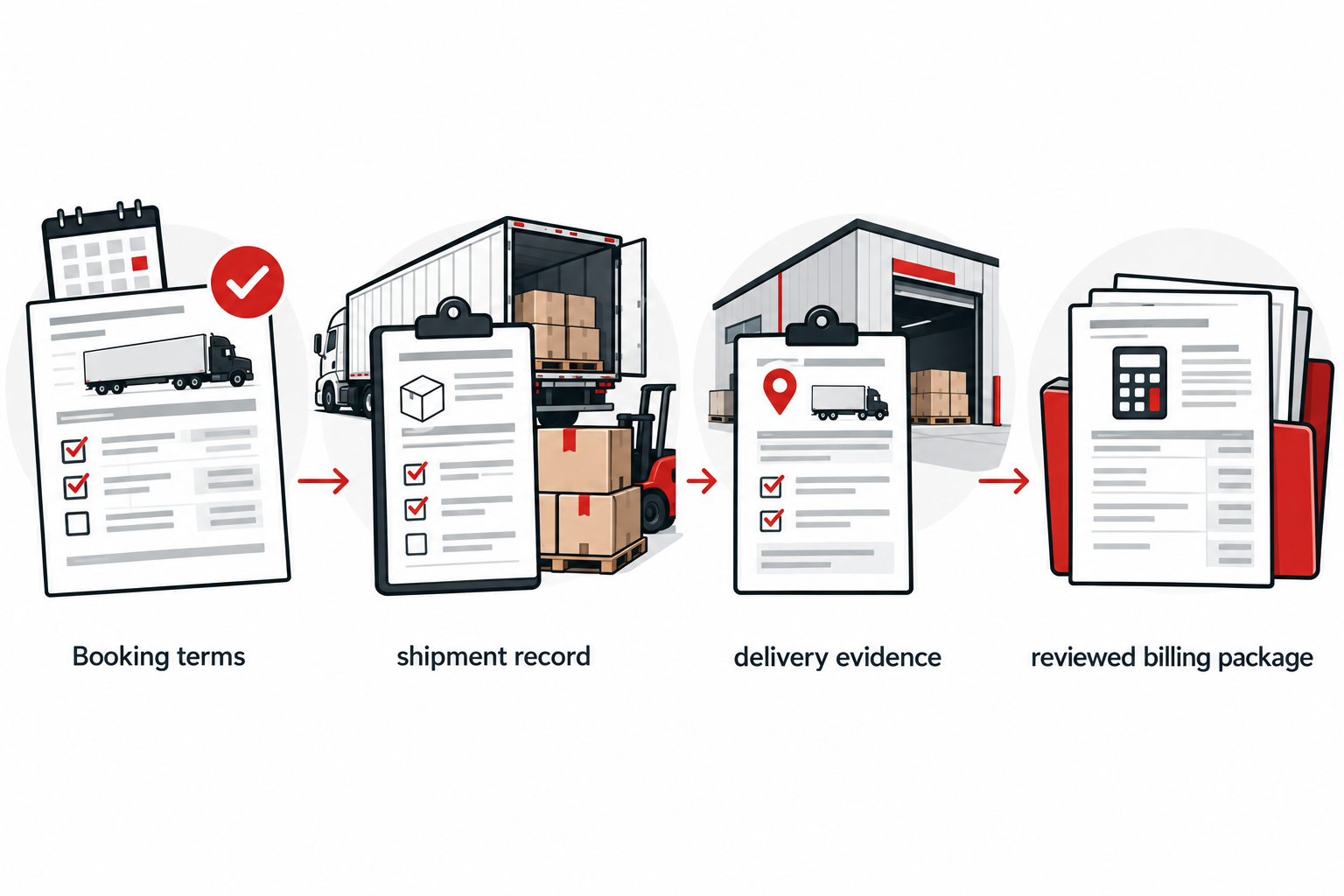
Match the billing package before submission
Use the shipment reference as the central link between documents. Compare the approved rate, approved extra charges, supporting evidence, and invoice amount. Ensure the billing destination and payment instructions are authorized and current.
Keep the carrier's transportation invoice separate from the dispatch service's own fee invoice. They represent different commercial relationships. The income and revenue guide explains why combining them creates misleading financial reporting.
Before submitting, ask whether another person could understand the package without reading the entire message history. If the answer is no, add a concise cover summary rather than forwarding a confusing chain of attachments.
Use explicit document statuses
A simple sequence can be: received, needs correction, complete for review, approved for submission, submitted, and acknowledged. Do not call a shipment “paid” just because the invoice was sent.
For every incomplete item, record the missing information, responsible person, and next action. “Waiting on paperwork” is not a useful long-term status unless someone owns the follow-up.
Use consistent filenames and permissions. For a fictional shipment, a name such as TT-104_POD_v1 is more useful than photo-new-final-2. Keep originals and subsequent corrected copies distinguishable.
Reconcile the folder after closeout
Confirm that the final package and approval record are stored in the agreed location. Remove unnecessary duplicate working copies where your retention and security policy allows, while preserving the records the carrier needs.
Follow the applicable retention requirements and contract terms rather than assuming this article sets a universal retention period. Different documents and legal contexts may require different treatment.
Frequently asked questions
Can a signed BOL be proof of delivery?
It may be accepted as delivery evidence in the particular workflow. Confirm that the actual copy contains the required delivery acknowledgment and satisfies the recipient's requirements.
Is POD the same as proof of payment?
No. Delivery evidence and payment evidence describe different events. Track delivery, invoicing, acknowledgment, and collection separately.
Should a dispatcher fix a missing signature digitally?
No. Do not create or imitate a signature. Request legitimate documentation through the authorized process and escalate unresolved issues.
Make closeout part of dispatching, not an afterthought
Pair this workflow with the rate-confirmation checklist and accessorial documentation guide. Explore Trucking Territory's training to understand how paperwork connects the operational and billing stages.
Sources and further reference
Worked scenarios and checklists in this article are educational examples or editorial recommendations, not promised business results.
