Rate Confirmation Checklist: What to Review Before Acceptance
A rate confirmation records the commercial and shipment details for a particular load. Before accepting it, compare the document with the terms discussed and the carrier's instructions. Check more than the total payment: identity, appointments, cargo, special requirements, billing, and changes can all affect the assignment.

Understand what the document is for
TruckingOffice's rate-con explanation describes the document as confirmation of shipment movement and pay, with additional terms that may address payment, cancellation, and other conditions. The exact form and legal effect depend on the actual documents and arrangement.
Use this article as an operational review checklist, not a legal interpretation of a contract. Unclear liability, indemnity, penalties, or conflicting agreements should be reviewed by the carrier and appropriate professional support.
Check the parties and shipment reference
Match the carrier's legal name and identifying information with the intended assignment. Confirm the broker or other authorized counterparty through the approved verification process. Check that the shipment reference is consistent across the email, document, and working record.
Do not rely on a familiar logo as proof of identity. FMCSA's fraud alerts show why apparently official or familiar communications still deserve scrutiny. When contact or payment details change unexpectedly, stop and verify through an independently established channel.
Review operational details line by line
| Review area | What to compare with the agreed plan |
|---|---|
| Locations | Complete pickup, delivery, and additional-stop addresses |
| Appointments | Dates, local time zones, windows, and reference numbers |
| Equipment | Trailer type, dimensions, loading method, and required accessories |
| Cargo | Commodity, weight, special handling, and unresolved restrictions |
| Communication | Check-in, tracking, escalation, and update requirements |
| Documents | Required shipment, delivery, and billing records |
A correct city name does not prove the street address is correct. A correct date does not prove that the time zone or appointment type matches the call. Resolve the mismatch rather than choosing whichever version is easier to perform.
Separate confirmed pay from conditional charges
Identify the agreed base payment and any separately stated components. Review how extra stops, detention, layover, cancellation, or other relevant charges are requested and approved. Record the supporting evidence and submission conditions the actual agreement requires.
Do not write a possible charge into confirmed revenue before it is approved. Conversely, do not lose track of a documented request simply because the base load has delivered. Keep requested, approved, invoiced, and collected amounts distinct.
Check the carrier's approval and signing process
Determine who may accept or sign the document and in what capacity. Access to a document does not establish authority to bind the carrier. Use the limits defined in the dispatch-service agreement and the carrier's internal instructions.
If a broker sends revised terms after approval, review the affected details again. A new pickup window can change feasibility; a different commodity can change equipment or insurance questions. “Only one line changed” is not a reason to skip the check.
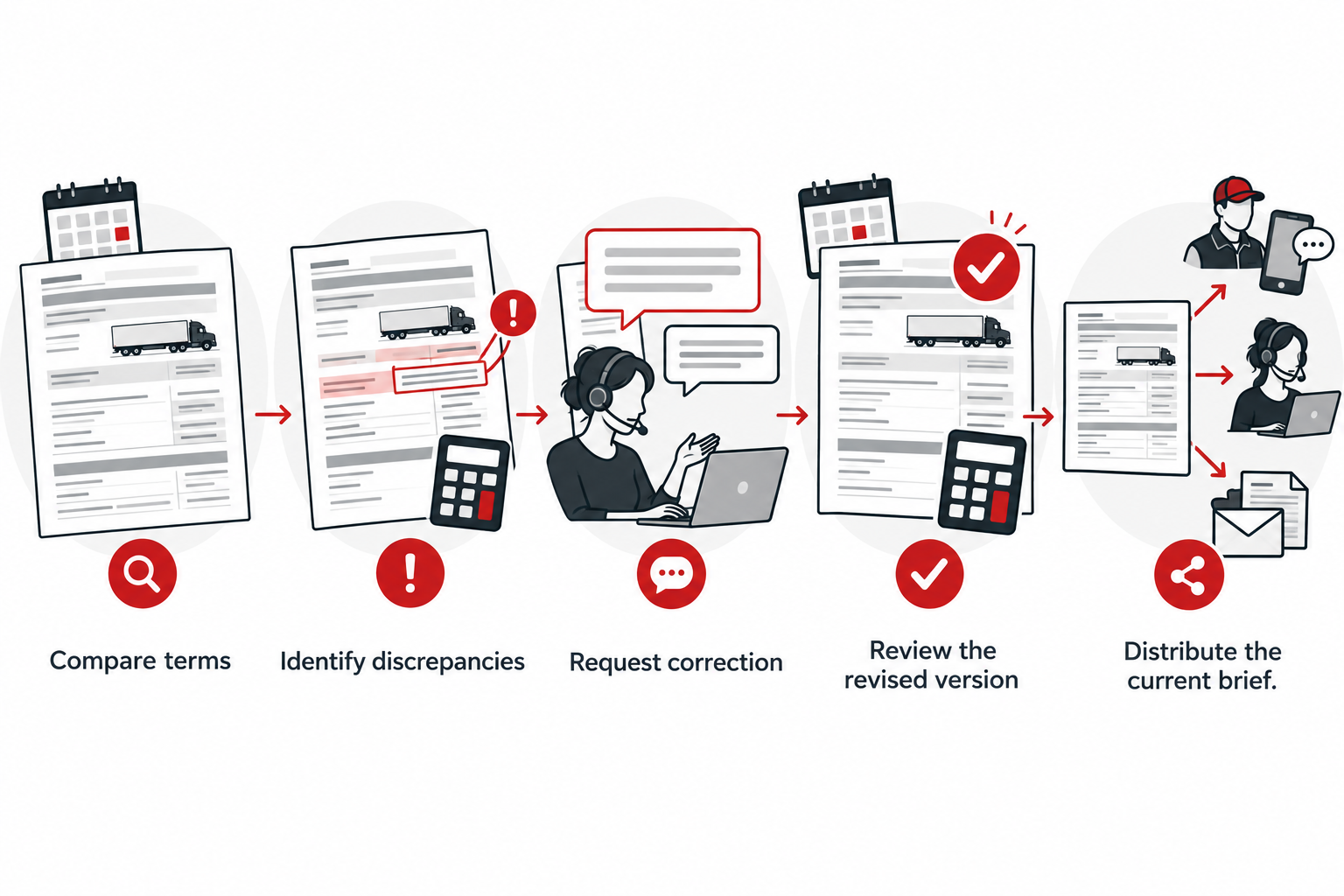
Maintain a version history
Save the original received document, the correction request, and the approved revised version. Use a naming convention such as shipment reference, document type, and version number. The exact convention is less important than applying it consistently.
Mark which version governs the current operating plan and distribute that version to the authorized people who need it. Do not silently overwrite a file and assume that everyone has stopped using the old attachment.
A fictional correction message could read:
The document shows a pickup window that differs from the one discussed. Please confirm the intended appointment and issue a revised confirmation before we complete the approval process.
Keep the message factual. Do not alter the counterparty's document yourself to make it match the call.
Finish with a trip brief
Once the terms are resolved, summarize the shipment for the driver and carrier through the approved channel. Include the information needed to act, the source document, and the escalation contact. A trip brief should not conceal conditions in the full confirmation or replace required review.
Make the brief easy to update. When the plan changes, show the changed item and timestamp rather than sending a completely unexplained new message.
Frequently asked questions
Is a rate confirmation the same as a bill of lading?
No. They serve different functions in the shipment workflow. Read the BOL and POD guide to see how booking, shipment, delivery, and billing records connect.
Can I accept a document with the wrong appointment if the broker says it is fine?
Resolve the conflict through the carrier's approval process and obtain an appropriate written correction or clarification. Do not leave the operating record knowingly ambiguous.
Does a signed rate confirmation guarantee payment?
No document should be treated as a guarantee that funds will be collected. Follow counterparty review, performance, documentation, and billing procedures.
Make document review a repeatable task
Use the broker-verification checklist before trusting new instructions. Explore Trucking Territory's training to understand how the rate confirmation fits into the complete dispatch workflow.
Sources and further reference
Worked scenarios and checklists in this article are educational examples or editorial recommendations, not promised business results.
