Dispatch Service Agreement Checklist for Carriers and Dispatchers
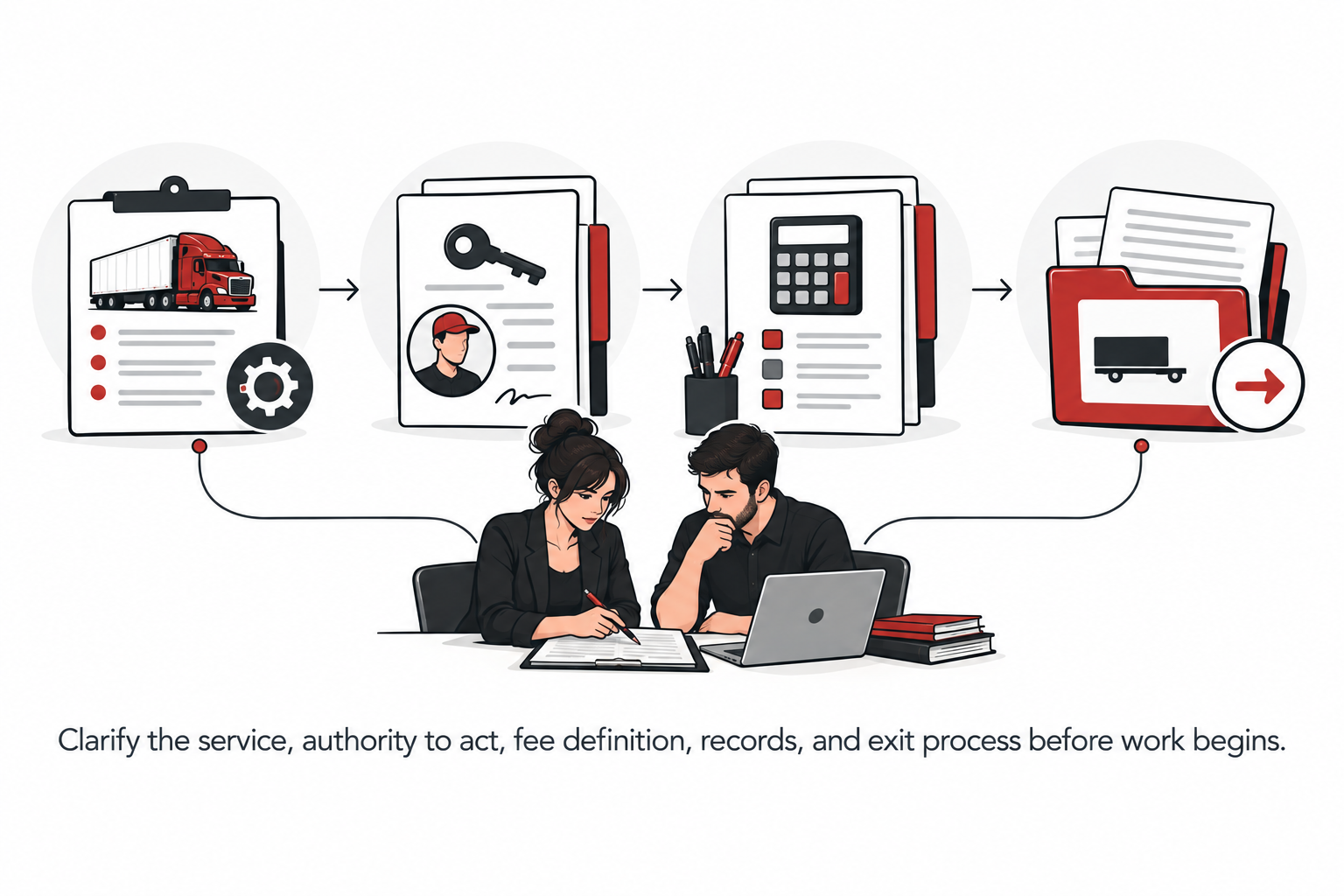
A dispatch service agreement should make the working relationship understandable before a shipment creates pressure. It needs to explain the service scope, permission to act, carrier approvals, compensation, records, and exit process. This article is a business-review checklist for discussion with a qualified attorney, not a ready-to-sign contract.

Start with the actual operating relationship
Identify the correct legal parties and their authorized representatives. Then describe the service in concrete terms. “Dispatch support” is too broad if the parties have different expectations about calls, signing, tracking, paperwork, billing, and after-hours coverage.
List included tasks and exclusions together. The carrier should not need to infer whether claims handling or safety management is part of a fee simply because both activities relate to a truck. For the underlying distinction between roles, read the dispatcher-versus-broker guide.
Define authority to act
Discuss which actions require advance approval and how that approval will be recorded. For example, researching an option, negotiating within an approved range, signing a document, and changing a payment instruction are different permissions.
Create an approval matrix alongside the legal document. The matrix is an operational reference; it does not replace the agreement. Keep the two consistent and review the legal arrangement if the actual service changes.
| Action | Question for the agreement review |
|---|---|
| Propose a load | What information must be provided first? |
| Negotiate terms | Are there limits or mandatory approval points? |
| Sign or submit documents | Who has authority, and in which capacity? |
| Request an extra charge | Who documents, approves, and follows up? |
| Change financial details | What independent verification and authorization apply? |
Define compensation without ambiguous shorthand
If a percentage fee is used, identify the revenue base, timing, adjustments, and exclusions. If a flat fee is used, identify the service period and what changes when a truck is inactive. State how disputed fees are handled and who receives supporting records.
Consider a fictional $2,000 shipment and a 5% dispatch fee. The calculation is $100 only if the full $2,000 is included in the agreed base. If the base excludes certain components, the same percentage can produce a different fee. The contract, not an assumption about the word “gross,” should settle the definition.
Also discuss whether the fee is triggered by booking, delivery, invoicing, or collection. Each choice changes cash-flow expectations and should be understood before the first invoice.
Allocate communication and recordkeeping duties
Specify how availability is confirmed, how appointment changes are communicated, who maintains the current trip record, and who responds after the normal coverage period. A promise to “stay in touch” is difficult to measure or hand over.
Define where documents are stored and which party can access them. Keep access limited to the agreed purpose. The FMCSA fraud alerts provide a useful reminder that payment and identity communications require independent verification; the agreement should support a secure operating process rather than relying on trust in any incoming message.
Decide what happens when a load changes
Discuss cancellation, delayed pickup, changed commodity, disputed extra charges, rejected delivery, and missing paperwork as separate scenarios. Identify who can communicate a commitment and who must be consulted.
Do not write an operational procedure that requires the dispatcher to promise a safety outcome or instruct a driver to violate rules. When an assignment is no longer workable, the process should make escalation and revised instructions possible.
Ask counsel to review liability, indemnity, insurance, dispute resolution, governing law, and any personal guarantee. Those clauses can have consequences that a plain-language checklist cannot evaluate for your specific business.
Plan termination before the relationship starts
A workable exit process addresses notice, open loads, outstanding invoices, documents, account access, and the person who assumes responsibility. Define a handoff method that does not leave a shipment without a current contact.
The practical test is straightforward: if the relationship ended tomorrow, could each party identify every active shipment and pending obligation? If the answer depends on searching one person's private phone, improve the recordkeeping process before launch.
Frequently asked questions
Does signing an agreement automatically make a service legally compliant?
No. The actual activities still need to fit the applicable requirements. A document should accurately describe the relationship, not be used as a label that contradicts it.
Can I copy a free contract from the internet?
A generic document may omit important facts or allocate risk in ways you do not understand. Use a checklist to prepare your decisions, then obtain review appropriate to the actual arrangement.
Should a rate confirmation replace this agreement?
Do not treat a shipment-specific document as a complete definition of the ongoing carrier–dispatch-service relationship. Have the relevant documents reviewed together for consistency.
Prepare the business decisions before drafting clauses
Complete the carrier-onboarding checklist and identify every permission the workflow needs. Explore Trucking Territory's training to understand the shipment process that the agreement must support.
Sources and further reference
Worked scenarios and checklists in this article are educational examples or editorial recommendations, not promised business results.
