Truck Dispatcher vs. Freight Broker: Where the Roles Differ
A truck dispatcher and a freight broker may both discuss freight, prices, and pickup times, but their roles are not interchangeable. The key question is not which software they use. It is whose operation they represent and what transportation-arranging activities they actually perform.

Compare the business relationship first
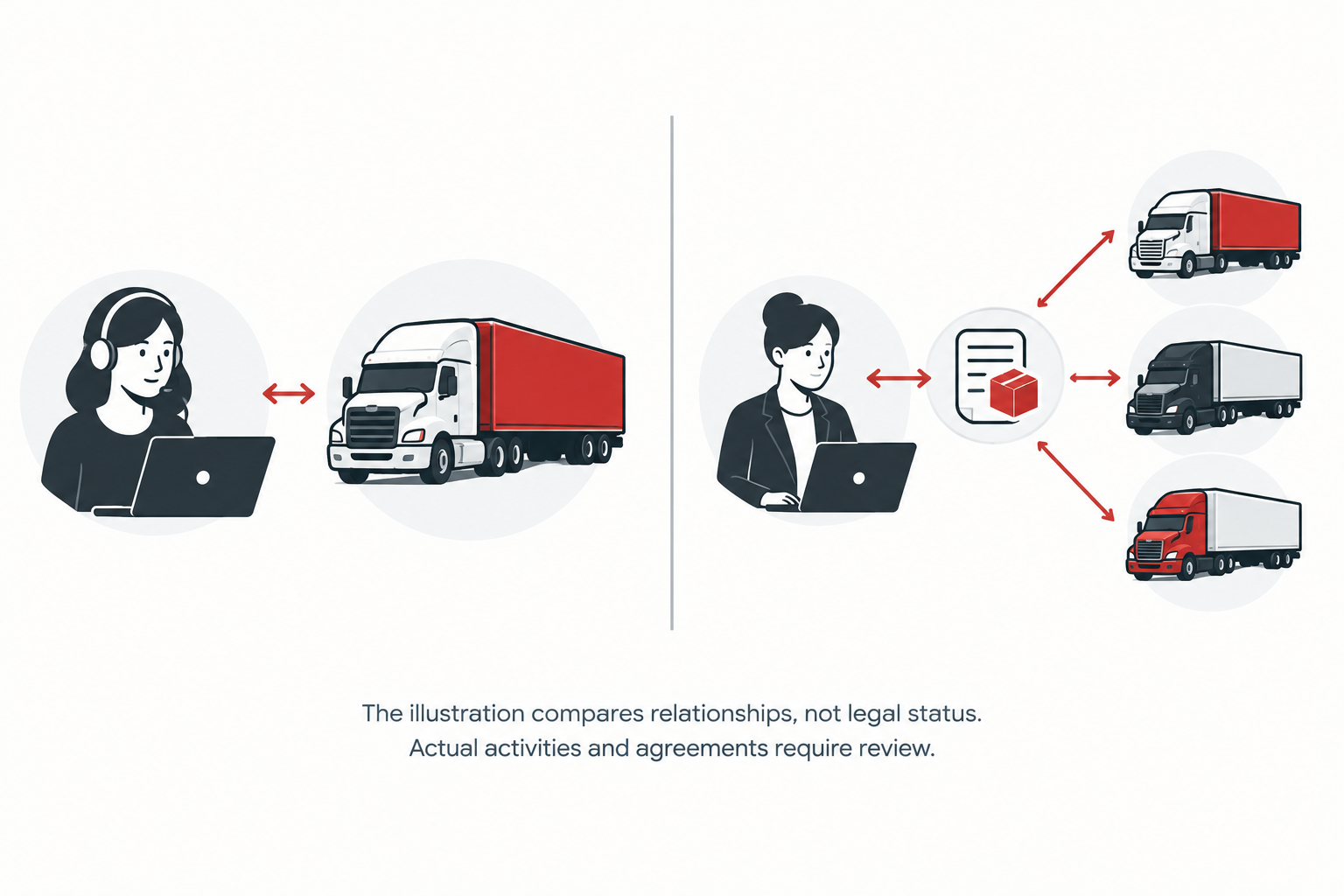
For a practical comparison, imagine a carrier deciding what freight its truck should haul versus a business arranging transportation between shipping demand and available carriers. The communications can look similar while the commercial relationships differ substantially.
| Question | Carrier-side dispatch arrangement | Freight-brokerage arrangement |
|---|---|---|
| What problem is being solved? | Coordinating the represented carrier's operation | Arranging transportation using motor carriers |
| What should the operating record show? | The carrier relationship and approval process | The brokerage's authorized role and transaction records |
| What is the central compliance question? | Whether the actual activities fit the represented role | Whether required broker authority and obligations are satisfied |
| What should not be inferred? | A dispatch label automatically creates an exemption | Software access alone establishes authorization |
This table is a simplified orientation. It is not a legal test or a complete description of every permitted arrangement.
What does FMCSA's guidance clarify?
FMCSA's 2023 final guidance treats the analysis as fact-specific. Relevant considerations include the carrier relationship, control, compensation, and whether the service allocates traffic among carriers. A written agreement matters, but a label or contract alone does not settle the issue. Serving multiple carriers is not automatically the same as unlawfully allocating freight among them.
That is why two businesses calling themselves “dispatch services” can need different legal advice. Their actual workflows may be different even if their websites use the same words.
Map the transaction before choosing a title
Draw the process for one proposed shipment. Record who receives the request, who agrees to provide capacity, when a particular carrier is identified, who approves the terms, who signs, and who pays whom.
Then compare that map with the written agreements and marketing claims. A website may say “we work only for carriers” while a salesperson promises a shipper that the business will arrange a truck. The mismatch is a reason to pause and obtain advice, not a wording problem to hide with a disclaimer.
For your internal review, keep the transaction map concrete. “We help with logistics” is too vague. “We receive a request from this party and make this commitment before this carrier is selected” gives counsel something useful to evaluate.
Examples that deserve professional review
Consider an independent service that wants to accept a shipment before it has identified the carrier that will haul it. Consider another that decides which of several overlapping carrier clients receives a load. Consider a payment arrangement in which transportation money passes through the dispatch service.
These examples are review prompts, not determinations that every arrangement with one such feature is unlawful. Explain the complete facts to a qualified transportation attorney before building the business around the activity. Do not ask a course certificate or a generic agreement template to answer a question about your actual transactions.
Broker authority is a separate business requirement
FMCSA's broker-registration instructions describe requirements including a $75,000 surety bond or trust fund and a process-agent designation. The $75,000 is the financial-security amount, not a statement that every applicant pays that amount as an annual insurance premium. Confirm the current application process and all applicable requirements directly.
This article does not recommend brokerage over dispatching. It recommends selecting the role intentionally and designing the operation around the obligations that follow.
Keep daily permissions aligned with the reviewed role
Once the model is reviewed, translate it into an operating procedure. Specify who can approve loads, sign documents, communicate commitments, and handle financial changes. Train anyone assisting the business on those limits.
Review the process again when you add a new service or client type. Moving from administrative carrier support into a different transportation-arranging activity is not merely an upsell; it can change the questions that require professional review.
Frequently asked questions
Can one person be both a dispatcher and a broker?
A person may have more than one business role, but the permissions, authority, contracts, and disclosures need to fit each activity. Obtain advice on the specific arrangement rather than treating the roles as interchangeable.
Does representing only one carrier remove every legal risk?
No. Review the actual work, agreements, claims, and applicable requirements. A single fact should not replace an assessment of the whole arrangement.
Is this article legal advice?
No. It is educational information about U.S. motor-freight operations. Have a qualified transportation attorney review the facts before relying on a business model.
Choose the role before buying the tools
Read the business-launch guide and dispatch-license explanation. For operational education rather than a promise of legal authorization, explore Trucking Territory's course.
Sources and further reference
Worked scenarios and checklists in this article are educational examples or editorial recommendations, not promised business results.
