Truck Dispatcher Salary: Employee Pay vs. Independent Revenue
Truck dispatcher salary and independent dispatch-service revenue are different measures. Employee pay compensates a worker. An independent service invoices clients and must cover its own business expenses. The freight revenue earned by a carrier is neither the dispatcher's salary nor the dispatch service's profit.

What does an official wage benchmark actually measure?
O*NET's profile for Dispatchers, Except Police, Fire, and Ambulance reports 2025 median wages of $24.20 per hour and $50,340 annually. This occupational category covers dispatchers across multiple industries. It is not a truck-dispatcher-only salary survey and does not measure the profit of an independent dispatch business.
Treat that figure as broad labor-market context, not a promise for a beginner, a remote contractor, or a particular city. Before comparing a job offer with a benchmark, check the occupation, year, location, scheduled hours, and compensation structure. An annual salary and a part-time hourly offer are not directly comparable without additional information.
Four numbers that should never be combined
| Measure | Who earns or receives it? | What it tells you |
|---|---|---|
| Employee wages | The employee | Compensation for employment |
| Carrier freight revenue | The motor carrier | Revenue from transporting freight |
| Dispatch-service revenue | The dispatch business | Fees billed for agreed services |
| Dispatch-business profit | The business after applicable expenses | What remains under the chosen accounting definition |
A screenshot of a carrier's weekly gross does not establish the dispatcher's income. Likewise, an invoice issued by a dispatch service does not prove that the money has been collected.
A hypothetical dispatch-fee calculation
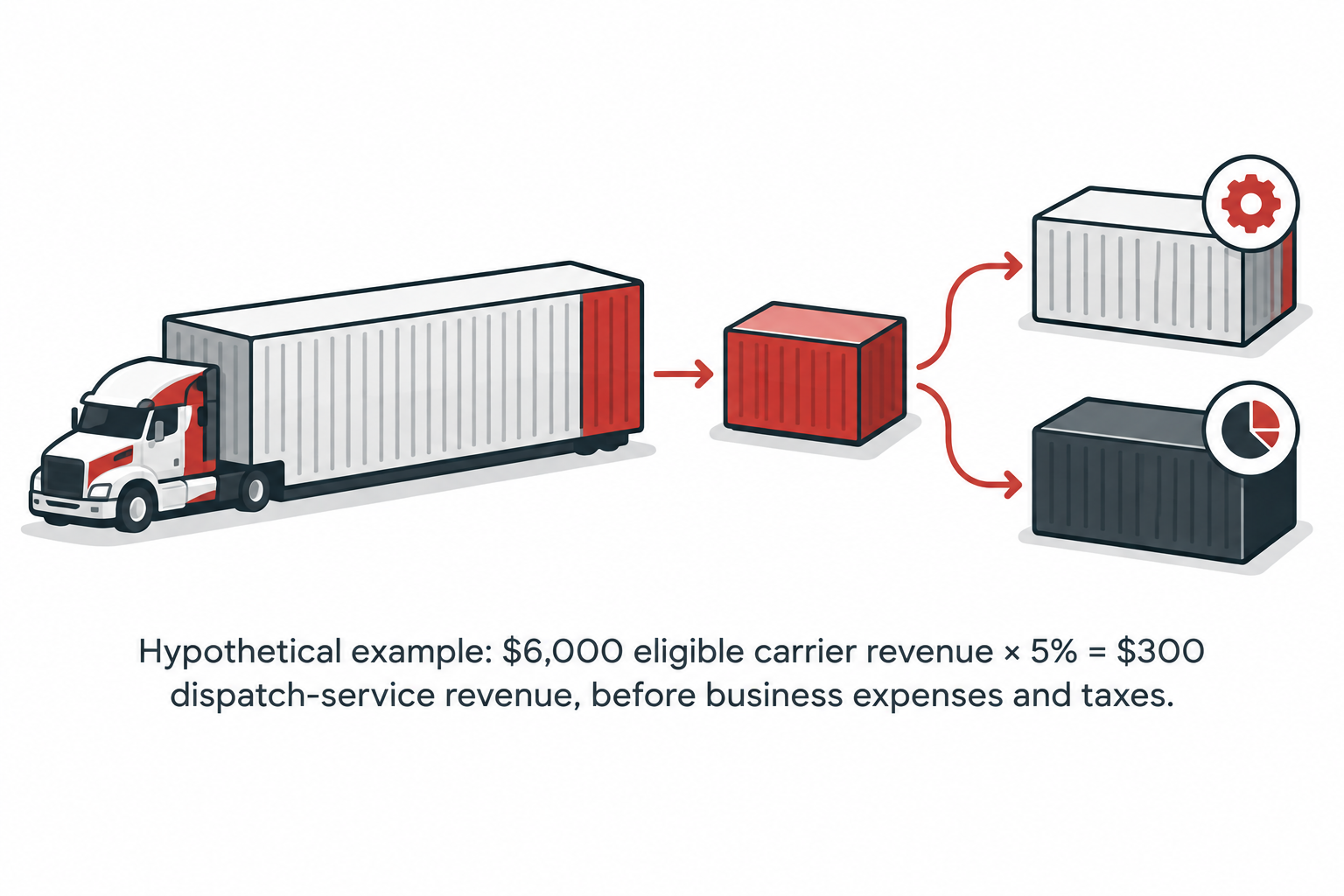
Suppose a carrier has $6,000 of freight revenue included in the fee base defined by its dispatch agreement. Suppose the negotiated dispatch fee is 5%. These are invented teaching inputs, not a statement about typical rates.
Dispatch fee = eligible revenue × agreed fee percentage
$6,000 × 0.05 = $300 in dispatch-service revenue.
The carrier's $6,000 is not the dispatcher's $6,000. The service's $300 is not automatically take-home pay. You still need to consider the service's expenses, collection timing, refunds or adjustments, and taxes appropriate to its circumstances.
The contract should explain what “eligible revenue” includes. Do approved accessorials count? What happens if a load is canceled? Is the fee earned at booking, delivery, invoicing, or collection? A percentage without a defined base can create disagreement even when everyone calculates correctly.
Why more trucks do not produce a simple income forecast
Multiplying one fictional truck's result by ten assumes that every truck has the same availability, workload, commercial performance, and collection outcome. It also assumes that service quality does not deteriorate as responsibilities grow.
Build a planning model around available working capacity instead. Estimate the time needed for searching, calls, updates, exceptions, and administration. Include nonbillable client-acquisition work and periods when a carrier is not operating. Then test a lower-volume scenario before adding expenses you must pay every month.
This is planning, not an earnings forecast. Replace assumptions with actual records once the business is operating.
Compare employee offers using the whole arrangement
Ask what the quoted pay covers. Record expected working hours, evening or weekend coverage, training arrangements, bonus conditions, and the employer's definition of performance. Review applicable employment terms with an appropriate adviser when needed.
A higher advertised figure can be less attractive if the conditions are unclear. A lower initial figure can also be unsuitable if the role has no workable supervision or asks you to handle responsibilities beyond your preparation. Evaluate the actual offer rather than a headline.
Build a simple independent-business dashboard
Track fees invoiced, cash collected, unpaid balances, direct expenses, overhead, and owner working hours separately. Agree on consistent accounting definitions with your accountant rather than mixing cash and accrual figures in one “profit” column.
For management purposes, add service-quality measures such as unresolved document issues and exceptions without an assigned owner. Revenue alone cannot tell you whether a client relationship is sustainable.
Frequently asked questions
Can a truck dispatcher make $8,000 per month?
A claim about a particular person's earnings needs supporting evidence and a clear definition of the number. Without those details, it cannot establish what a beginner should expect. Do not treat a promotional figure as a personal forecast.
Is a percentage fee always better than a flat fee?
Not necessarily. Compare the agreed scope, workload, fee base, billing conditions, and client expectations. Model both arrangements using the same assumptions before choosing a pricing approach.
Does a course determine my eventual salary?
No. Training is one input. Role requirements, demonstrated competence, hiring decisions, business execution, and the specific market also matter. No course can make an individual outcome certain.
Learn to evaluate the work behind the number
Read the guide to starting a dispatch service before building an income plan. To understand the operational skills involved, explore Trucking Territory's course curriculum.
Sources and further reference
Worked scenarios and checklists in this article are educational examples or editorial recommendations, not promised business results.
