How to Verify a Freight Broker Before Accepting a Load
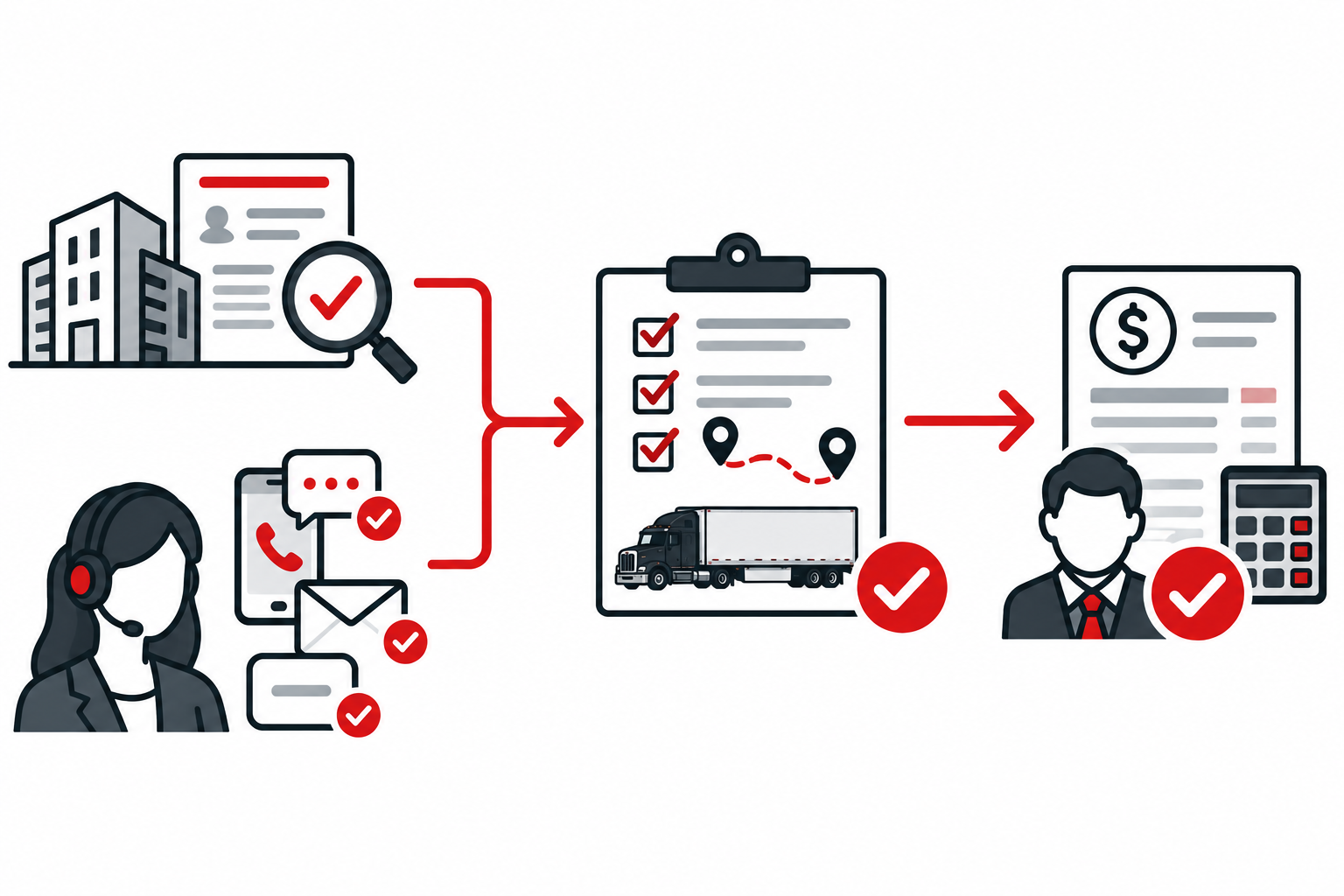
To verify a freight broker, check the business identity and relevant official records, authenticate the person contacting you, and compare the shipment and financial instructions for consistency. A legitimate company name does not prove that an email or phone caller is authorized to act for that company.

Separate company verification from contact verification
Think of the review as two questions. Does the business have the relevant status for the transaction? And is this specific person or message genuinely connected with the business?
An impersonator can copy a real company's name, logo, or registration identifier. Conversely, a familiar employee's account can be compromised. Your process should not collapse identity, authority, and payment risk into a single “verified” checkbox.
FMCSA's fraud alerts document deceptive communications and impersonation risks. Use them as a reason to maintain an independent verification procedure, not as proof that every unusual message is fraudulent.
Start from official records through trusted routes
Use FMCSA's current registration resources to locate the relevant public status and authority information. Confirm the entity and check the records appropriate to the proposed transaction, including financial-responsibility information where applicable.
The SAFER Company Snapshot provides company and safety-related information. A snapshot alone does not establish every authority, financial-security, contact-identity, or payment question. Do not use an old tutorial's screen sequence as a substitute for the current official lookup process.
Keep the time and source of the check in your working record. A result checked months ago may not answer today's question.
Authenticate the communication independently
For a new relationship or a suspicious change, contact the company through a channel established independently of the questionable message. Do not “verify” a new phone number by calling that same new number.
Compare the legal identity, domain spelling, shipment reference, and named contacts. Investigate unexplained inconsistencies rather than assuming a professional-looking PDF resolves them. An urgent request should trigger the existing procedure, not a shortcut around it.
Limit the information you disclose while verification is incomplete. There is no need to send sensitive carrier documents, driver details, or financial data to an unverified recipient merely because they request it urgently.
Apply a separate check to payment changes
Treat a new bank account, factoring instruction, payee, or billing destination as a distinct approval event. Confirm it through the carrier's authorized financial process and a trusted channel. Do not update payment details solely from an inbound email attachment.
If a factoring provider or other commercial tool supplies a credit or acceptance decision, understand its scope and conditions. Do not convert that information into a blanket promise that every loss or nonpayment is covered.
The dispatcher's role is to preserve the facts and route the decision to the authorized person, not to approve financial changes beyond the agreed scope.
Watch the shipment for inconsistencies after booking
Continue checking when material details change. A sudden destination change, unexpected carrier substitution, request to conceal identities, or unfamiliar pickup instruction may need escalation. A previously verified counterparty does not make every later instruction automatically valid.
Some changes can have legitimate explanations. The correct response is verification and documented authorization, not an unsupported accusation. Keep communications factual and avoid publicly labeling a company fraudulent based on an unresolved discrepancy.
Use a simple verification record
| Record field | What to preserve |
|---|---|
| Entity | Legal name and relevant identifiers |
| Official review | Source, time, and relevant status checked |
| Contact authentication | Independently established channel and result |
| Shipment consistency | References, locations, equipment, and changes |
| Financial changes | Authorized review and supporting record |
| Decision | Proceed, hold, or escalate, with responsible person |
This is a proposed control record, not a government-prescribed form. Adapt it to the carrier's agreements and risk-management procedures.
Know when to stop
Pause the affected commitment when a material question remains unresolved. Inform the carrier, preserve the message and document history, and follow the relevant incident-reporting process. If there is an immediate safety or theft concern, use the carrier's emergency procedures and appropriate authorities.
Do not alter suspicious documents to make them usable, and do not continue simply because time has already been spent on the load. Prior effort is not evidence that the risk has disappeared.
Frequently asked questions
Is an MC number enough to trust a broker?
No. Confirm the relevant current records and authenticate the actual contact. An identifier can be copied into a false communication.
Does an active authority record guarantee payment?
No. Regulatory status, contact identity, contract performance, and financial collection are different questions.
Should I accuse the sender if details do not match?
First preserve the evidence and verify through the carrier's procedure. A discrepancy needs investigation; it is not automatically a proven allegation.
Make verification part of every material change
Pair this process with the rate-confirmation checklist and carrier-onboarding guide. Explore Trucking Territory's course to learn the wider workflow in which these checks belong.
Sources and further reference
- FMCSA — Fraud Alerts
- FMCSA — Registration and current registration-system resources
- FMCSA — SAFER Company Snapshot
Worked scenarios and checklists in this article are educational examples or editorial recommendations, not promised business results.
