What Is a Truck Dispatcher? A Practical Guide to the Role
A truck dispatcher helps a motor carrier coordinate freight, drivers, schedules, and load information. The practical job is to turn an available truck into a workable trip, then manage changes until the shipment and its paperwork are complete. It is an operations role, not simply a job that involves finding the highest advertised rate.

What does a truck dispatcher actually do?
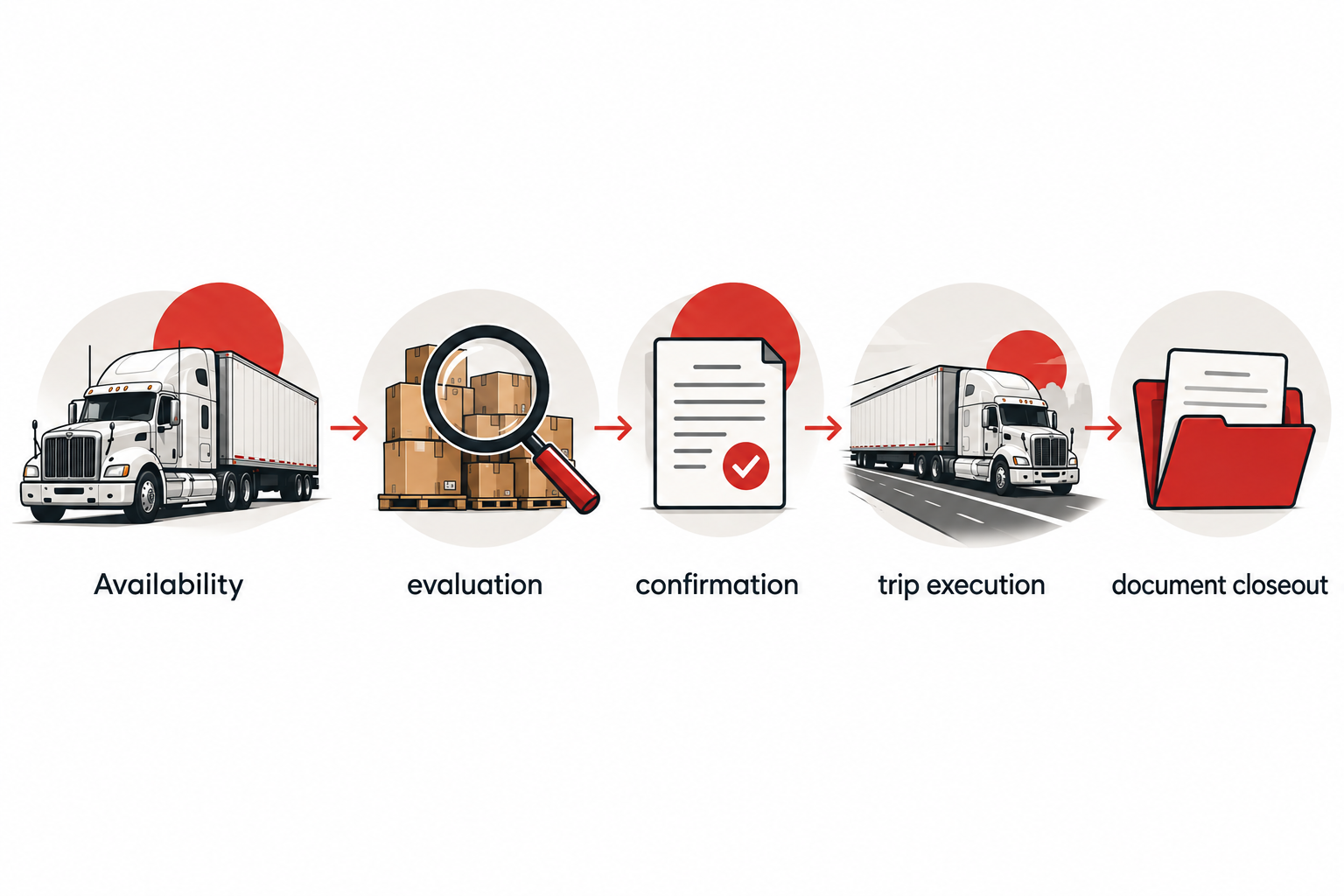
The work usually begins before a load is booked. A dispatcher checks the truck's location, equipment, availability, carrier preferences, and driver-reported operating constraints. Only then does it make sense to search for freight. The broad occupational tasks in O*NET's dispatcher profile include scheduling, communicating assignments, and maintaining records; the trucking workflow below applies those functions to a carrier's day.
| Stage | Useful dispatcher output | Question to resolve |
|---|---|---|
| Truck availability | Current truck profile | Where and when can this truck actually load? |
| Load evaluation | A short list of feasible options | Does the freight fit the equipment, time, and economics? |
| Booking preparation | Agreed terms and carrier approval | Are the shipment and payment terms clear? |
| Trip execution | Updates and exception log | Has anything changed that affects the plan? |
| Closeout | Organized delivery and billing documents | Can the responsible billing person process the shipment? |
This is a useful starting model, not a claim that every employer assigns the same tasks. A larger carrier may separate dispatch, customer service, safety, and billing. A small operation may combine several responsibilities.
Who does the dispatcher work for?
An employee works within the employer's structure. An independent dispatch service has its own service relationship with a carrier. Neither job title, by itself, settles the legal boundary between dispatching and brokerage. FMCSA's guidance evaluates the actual activities and relationship, rather than treating the word “dispatcher” as an automatic exemption.
For day-to-day work, write down three boundaries: what the dispatcher can propose, what the carrier must approve, and what requires escalation. A dispatcher should not assume permission to sign documents, change payment instructions, or make safety decisions simply because they have access to a carrier's inbox.
What a realistic assignment looks like
Consider a hypothetical dry-van truck that becomes empty in the afternoon. One posted load pays more but requires pickup before the truck can reasonably arrive. Another fits the pickup window but delivers somewhere the carrier does not want to operate. A third has a lower headline payment but fits the equipment, schedule, destination, and carrier's cost model.
The dispatcher's useful contribution is explaining those tradeoffs clearly. “This option pays the most” is a weaker recommendation than “This option meets the timing constraints and has the strongest expected result across the whole trip.” No outcome is guaranteed: the broker still needs to confirm availability, and the carrier still needs to approve the plan.
Which skills matter before you manage a truck?
Start with accurate communication. Practice repeating appointment dates, time zones, addresses, reference numbers, and equipment requirements without changing their meaning. Follow a call with a written summary when a decision affects the trip.
Next, practice arithmetic and document control. You should be able to explain loaded miles versus total miles, identify which rate-confirmation version is current, and find a delivery document without searching through multiple private chats.
Finally, practice exception handling. A useful update says what happened, what it changes, what has already been checked, and when the next update will arrive. It does not hide uncertainty behind “everything is fine.”
How can a beginner test their understanding?
Build a fictional truck profile and compare three fictional shipments. Reject the ones that fail a hard constraint before comparing revenue. Write a booking summary for the remaining option, then introduce a two-hour loading delay and revise the plan.
Use invented company details and label the exercise as a simulation. A training exercise is evidence of your process, not evidence that you have managed a real customer account.
Frequently asked questions
Is a truck dispatcher the same as a freight broker?
No. The roles can involve similar communication tools, but the business relationships and legal responsibilities are different. Read the dispatcher-versus-broker guide before choosing a business model.
Does a dispatcher drive the truck?
Driving and dispatch coordination are different functions. A dispatch job should not be confused with a truck-driving role or advertised as a substitute for the qualifications required to drive.
What should I learn first?
Learn the shipment workflow and basic vocabulary, then practice load evaluation and written communication. The beginner learning roadmap gives you a sequence to follow.
Turn the role into a learning plan
Explore Trucking Territory's course curriculum and compare it with the skills you still need to practice. Choose training by the decisions it helps you make, not by promises of a particular income.
Sources and further reference
- O*NET — Dispatchers, Except Police, Fire, and Ambulance (43-5032.00)
- FMCSA — Definitions of Broker and Bona Fide Agents, June 16, 2023
Worked scenarios and checklists in this article are educational examples or editorial recommendations, not promised business results.
