How to Choose a Truck Dispatcher Course Without the Hype
A useful truck dispatcher course should help you make and explain operational decisions: assess truck availability, compare loads, communicate terms, organize documents, and respond to changes. Evaluate the curriculum and practice format before considering promotional income claims or the number of lessons.

Turn the curriculum into observable skills
A topic name is not the same as a learning outcome. “Load boards” might mean a brief screen tour or a detailed exercise comparing freight for a specific truck. Ask what you will be able to do after the lesson.
Use a simple test: can the provider show a sample task, explain the expected output, and describe how a beginner can check the result? This helps you compare programs that use different labels for similar material.
| Curriculum area | A useful practice output |
|---|---|
| Industry roles | Explain who is responsible for each stage of a shipment |
| Equipment and availability | Complete a fictional truck profile |
| Load search | Compare options against the same constraints |
| Trip economics | Calculate loaded and all-mile revenue consistently |
| Broker communication | Produce an accurate call summary |
| Documents | Assemble and check a simulated shipment folder |
| Exceptions | Revise a plan after a delay or changed requirement |
This checklist is our evaluation framework, not an accreditation standard.
Ask what “practical” means
Practical training can include worked examples, guided simulations, demonstrations, assignments, or supervised live work. Those formats are not interchangeable. Ask which are included and which are not.
A screen recording can explain a process, but it does not prove that you can repeat the process with different inputs. Build time into your learning plan to redo calculations, summarize calls, and identify errors without following the instructor's exact example.
If a provider offers real operational access, ask who supervises the work and what permissions apply. Do not use another carrier's identity or shared account credentials just to imitate a lesson.
Check how the course treats legal boundaries
A responsible curriculum should distinguish career training from business authorization. It should also explain that a job title does not determine whether a proposed independent operation requires broker authority. That boundary is addressed in FMCSA's broker and bona fide agent guidance.
A completion certificate should be described as a completion certificate, not as a federal dispatcher license. Be cautious when a sales page uses words such as “licensed,” “certified,” or “approved” without identifying the issuing body and exact meaning.
Inspect support and access terms separately
Write down the access period, format, language, supported devices, and whether downloadable materials are included. Ask how updates are handled when a software interface or operational requirement changes.
Treat mentoring, feedback, community access, and job assistance as separate features. Do not assume they are included because a course is described as comprehensive. Likewise, review the current refund policy and checkout terms rather than relying on a social-media comment or an old screenshot.
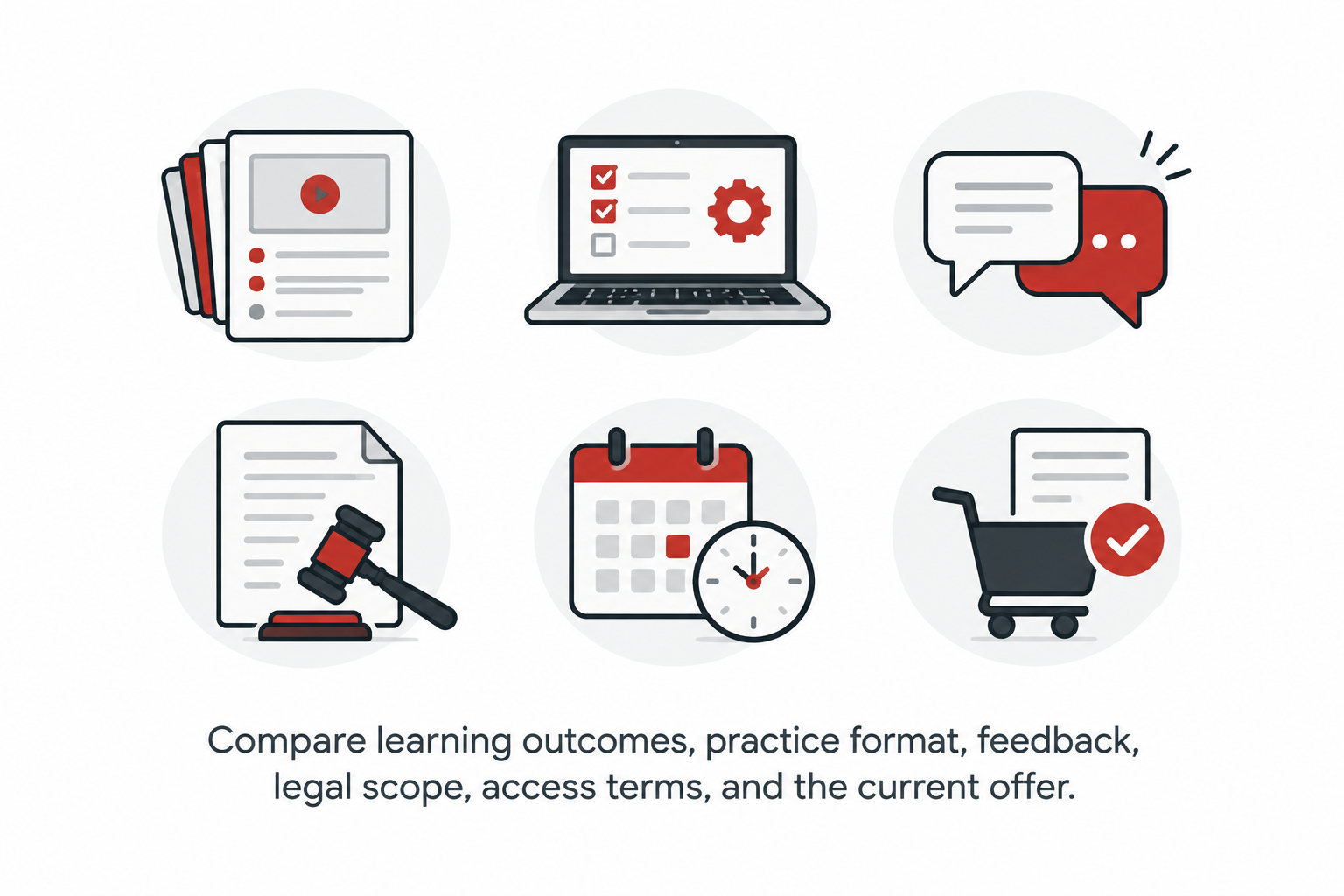
What is currently described for Trucking Territory?
The Trucking Territory course page, reviewed for this article, describes an English-language program with two modules, 56 lessons, approximately 10 hours of material, and lifetime access. Those product details describe the format, not a guaranteed time to proficiency or an employment outcome.
Use the live curriculum and checkout terms to confirm the current offer before purchasing. This article intentionally does not quote a course price, because promotions and offers can change independently of the educational comparison.
As the course provider, we recommend applying the same checklist to our program that you would apply to another provider. Identify the skills covered, check the format, and decide what additional practice or support you will need.
Compare two courses without a misleading score
Create one row per decision that matters to you. Record whether the provider clearly answers it, whether evidence is available, and whether the feature matches your needs. Do not invent a numerical “quality score” when you have not reviewed the actual lessons.
A shorter program can be useful for a focused need. A longer program can still be a poor fit if it repeats general information and never asks you to make a decision. Course length alone does not resolve the comparison.
Frequently asked questions
What is the best truck dispatcher course for a beginner?
There is no evidence-based universal winner for every learner. Start with your skill gaps, language needs, budget, practice requirements, and available support. Compare actual course materials where possible.
Is a course enough to start managing trucks independently?
Not automatically. Test your ability through realistic exercises, feedback, and a clearly reviewed operating process before taking live responsibility.
Should I buy training because it promises a high monthly income?
Evaluate the training itself. Earnings claims require evidence, clear definitions, and relevant context; they are not a substitute for a useful curriculum.
Review the curriculum with a specific goal
Open Trucking Territory's course page with one question in mind: which operational decision do you need to learn next? Use the beginner roadmap to turn the course into a practice plan.
Sources and further reference
Worked scenarios and checklists in this article are educational examples or editorial recommendations, not promised business results.
