Do You Need a License to Be a Truck Dispatcher?
There is no stand-alone federal “truck dispatcher license” that replaces any authority required for the activities you perform. For an independent service, the important question is whether the proposed work stays within an appropriate carrier-side relationship or requires broker authority. Business registration and local requirements are separate questions.

Why the question needs more than yes or no
“Dispatcher” can describe an employee position, an administrative service, or a business that performs broader transportation-arranging activities. Those are not necessarily the same arrangement.
FMCSA's guidance explains why dispatch-service activities need a fact-specific analysis. Do not interpret a course advertisement saying “no license needed” as clearance for every service you might later sell. Describe the actual work before seeking an answer.
The framework in this article concerns U.S. motor-freight operations. It is not a statement about requirements in every state, country, commodity segment, or transportation mode.
Separate three types of documentation
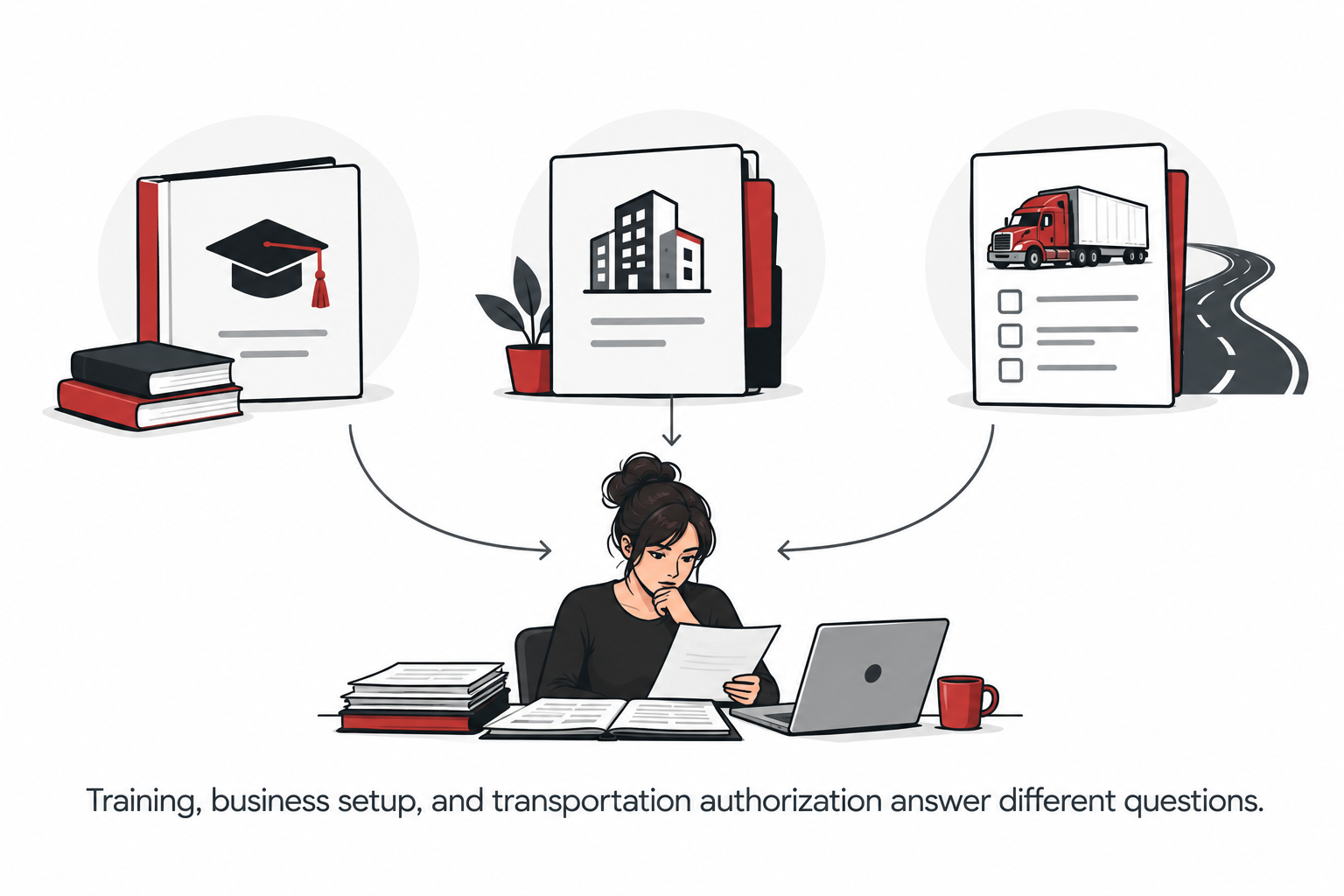
| Document or status | What it addresses | What it does not establish by itself |
|---|---|---|
| Course completion certificate | Completion of a provider's program | Permission to conduct every transportation activity |
| Business registration | Formation or registration of a business | Required federal transportation authority |
| Applicable broker authority | Authorization for covered brokerage activities | Proof that an individual is operationally trained |
These categories answer different questions. A responsible launch may require work in more than one category, rather than searching for one document that supposedly covers everything.
Prepare a description of your proposed service
Before speaking with an adviser, write a one-page service map. Identify the parties you plan to approach, who will be your client, when a carrier is selected, who can approve a shipment, and how compensation is calculated and paid.
Add the exact promises you intend to make on your website. Include whether you will negotiate, sign, submit documents, or handle funds, and under whose authority. A professional can evaluate a specific workflow more meaningfully than a broad question such as “Can I dispatch trucks?”
Keep a second column for activities you do not intend to perform. This makes it easier to spot later scope changes. If a potential client asks for a new function, review it before adding it informally.
Review business requirements separately
Your entity structure, address, banking, bookkeeping, insurance, and tax obligations depend on your circumstances. The SBA's launch resources explain the general U.S. business-setup categories. They do not replace state-specific or cross-border professional advice.
For example, a person operating remotely outside the United States may need to review obligations where the work is performed as well as the U.S. business relationship. Buying a course or forming a U.S. entity does not automatically resolve those questions.
Ask providers to identify what they are actually supplying. “Business setup assistance” might mean a checklist, document filing, professional advice, or something else entirely. Do not assume the package includes a legal review of your transportation activities.
Use current official registration instructions
When an activity requires FMCSA registration or authority, start from the agency's current registration page, not an old screen recording or an unsolicited payment link. Registration systems and procedures can change.
If broker registration applies, review FMCSA's broker requirements directly and obtain help appropriate to your situation. Avoid treating a training provider, load-board seller, or social-media group as the final authority on your legal obligations.
Build a review record before launch
Keep the service description, reviewed agreements, adviser questions and responses, authority information where applicable, and internal permissions together. This does not create a legal exemption; it helps you operate consistently with the arrangement you actually reviewed.
Set a trigger for reviewing the model again. Examples include approaching a different type of customer, changing payment flows, hiring an assistant, or adding a new transportation-arranging service. A review tied to the original scope should not be assumed to cover every later expansion.
Frequently asked questions
Is a dispatcher certificate required by FMCSA?
Do not confuse a private educational certificate with federal transportation authorization. Ask the issuer what its certificate demonstrates and verify applicable requirements with official sources and qualified counsel.
Does a carrier's authority become my authority?
Do not assume that it does. Your permission to assist a carrier and the authority required for your own activities are questions that must be evaluated separately.
Can this checklist replace a lawyer?
No. It helps you prepare the facts for a more useful consultation. The answer depends on your actual activities, agreements, and jurisdiction.
Build competence and authorization in parallel
Use the beginner learning roadmap for operational preparation and the business checklist for launch planning. Trucking Territory's course is educational training, not a promise of government licensing or individualized legal clearance.
Sources and further reference
- FMCSA — Definitions of Broker and Bona Fide Agents, June 16, 2023
- U.S. Small Business Administration — Launch Your Business
- FMCSA — Registration and current registration-system resources
- FMCSA — Broker Registration
Worked scenarios and checklists in this article are educational examples or editorial recommendations, not promised business results.
