Truck Dispatcher Glossary: Essential Terms From Load Search to Delivery
Truck-dispatch terminology is easiest to learn in the order a shipment happens. A beginner does not need to memorize hundreds of abbreviations before practicing. Learn the parties, equipment, load-search terms, rate language, documents, appointments, and exceptions that appear from truck availability through delivery.

Parties and business roles
| Term | Plain-English meaning | Where it appears |
|---|---|---|
| Carrier | The motor carrier responsible for transporting the freight | The truck operation the dispatcher supports |
| Owner-operator | A person who owns and operates a commercial truck, often under their own or another carrier's authority | Carrier profile and operating decisions |
| Driver | The person operating the truck | Availability, pickup, transit, delivery |
| Broker | A business arranging transportation with motor carriers under applicable authority | Load search, negotiation, booking |
| Shipper | The location or party from which freight is picked up | Pickup instructions |
| Receiver / Consignee | The destination party or facility receiving the freight | Delivery instructions |
| Dispatcher | A person coordinating the carrier-side workflow or an independent service operating under a defined carrier relationship | Throughout the shipment |
The label “dispatcher” does not by itself determine legal authority. Independent services should review their actual activities and carrier relationships against FMCSA guidance.
Truck and trailer terms
Tractor is the powered unit. Trailer is the unpowered freight-carrying unit attached to the tractor. Common trailer categories include dry van, refrigerated trailer or reefer, and flatbed.
Power only generally means the carrier supplies the tractor while the trailer is provided through the freight program or another party. The exact trailer and operating requirements still need to be confirmed for each load.
Equipment type is more than a label. A dispatcher should record trailer type, dimensions or configuration where relevant, operational restrictions, and any carrier-approved equipment information needed to evaluate a load.
Load-board and search terms
Load board — a marketplace or platform where authorized participants can search, post, or match freight and capacity.
Origin — where the load begins.
Destination — where the load delivers.
Pickup date / delivery date — the calendar dates associated with shipment appointments.
Deadhead — truck movement without the booked freight, often the distance from current truck location to pickup.
Loaded miles — miles traveled while hauling the booked shipment.
Lane — an origin-to-destination market pair used to discuss freight movement and rates.
Backhaul — a return or follow-on load that moves the truck toward another desired market or home area. The term does not guarantee that the load is commercially attractive.
Rate and economics terms
Rate — the agreed transportation payment for the shipment under the rate confirmation or other applicable agreement.
Rate per mile (RPM) — a ratio. Always state whether you mean loaded miles or total miles.
All-in miles — a training term often used to combine loaded miles with relevant deadhead for decision analysis.
Accessorial — a charge or payment related to additional services or events such as detention, layover, or truck ordered not used, subject to the actual agreement and documentation.
Detention — waiting time beyond the relevant free-time or contract terms. Eligibility and payment depend on the agreed terms and evidence.
Layover — a delay that may cause the truck or driver to wait for an extended period, often into a later operating day. Again, the contract controls the commercial treatment.
TONU — “truck ordered not used,” commonly used when a truck was committed or dispatched but the load did not proceed. Terms vary.
Booking and document terms
Rate confirmation (RC) — the written document used in many broker-carrier transactions to confirm shipment and commercial terms. Review the current version before acceptance.
Carrier packet / setup — documents and information a broker may request when onboarding a carrier for the first time. Do not send sensitive documents to an unverified party.
MC number — an operating-authority identifier used in FMCSA processes for entities that require MC authority. Do not use it as the only identity-verification signal.
USDOT number — an identifier used by FMCSA for covered entities and safety records.
Certificate of Insurance (COI) — evidence of insurance information. It does not replace verification through trusted channels.
W-9 — an IRS tax-information form commonly requested in U.S. business onboarding.
BOL / Bill of Lading — a shipment document associated with the freight and pickup process.
POD / Proof of Delivery — delivery evidence used to document completed delivery. A signed BOL may sometimes function as delivery evidence depending on the process.
Appointment and timing terms
FCFS / First come, first served — a facility may receive trucks in arrival order during a stated window rather than by a single appointment time.
Appointment — a scheduled pickup or delivery time or window.
ETA — estimated time of arrival. It should be based on current information, not invented to satisfy a status request.
HOS / Hours of Service — federal rules governing driving and duty time for covered commercial drivers. FMCSA's property-carrying rules include an 11-hour driving limit after 10 consecutive hours off duty and a 14-hour driving window, among other provisions. A dispatcher should plan around driver-reported availability rather than guessing from distance alone.
Common operational abbreviations
- PU — pickup.
- DEL — delivery.
- DH — deadhead.
- RPM — rate per mile.
- RC — rate confirmation.
- BOL — bill of lading.
- POD — proof of delivery.
- HOS — hours of service.
- ETA — estimated time of arrival.
- TONU — truck ordered not used.
Abbreviations are useful only when everyone understands them. In customer-facing or safety-sensitive communication, clarity is more important than shortening a message.
Learn terms through one shipment
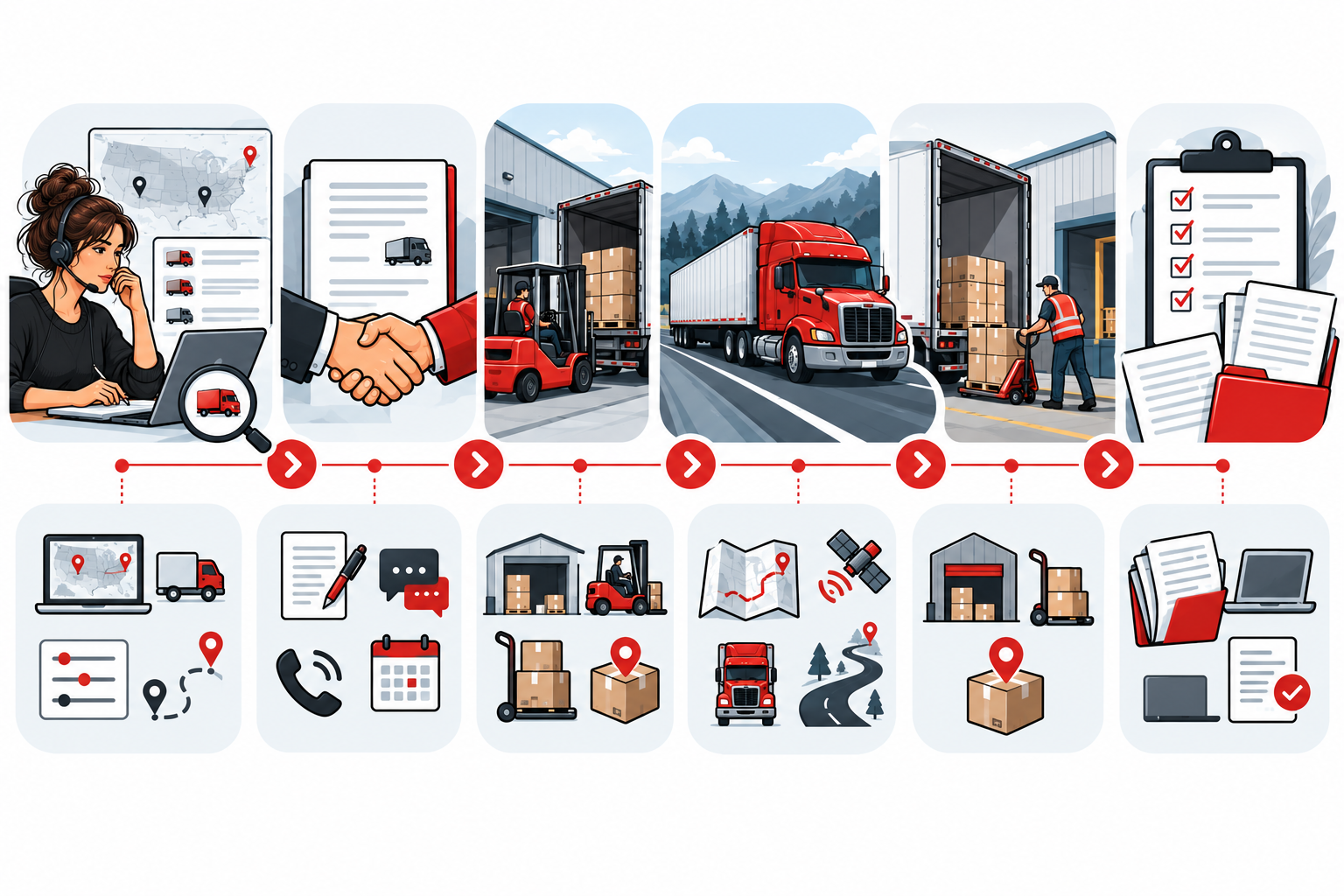
Create a fictional load and highlight each term as it becomes relevant:
- carrier confirms truck availability;
- dispatcher searches a load board;
- compares deadhead, loaded miles, and RPM;
- calls the broker;
- receives the RC;
- driver reaches the shipper;
- pickup produces a BOL;
- the trip is managed around HOS and appointments;
- the receiver signs delivery evidence;
- the dispatcher organizes the POD for closeout.
This method teaches context rather than memorization.
Frequently asked questions
Is a broker the same as a dispatcher?
No. They can discuss the same shipment, but the relationships and legal responsibilities differ. See the dispatcher vs. freight broker guide.
Is “gross” the dispatcher's income?
No. “Gross” can refer to carrier freight revenue, while a dispatch service may charge a defined fee. Read the salary and independent revenue guide.
Should I memorize every term before using a load board?
No. Learn enough vocabulary to understand the workflow, then build a glossary of terms you encounter during realistic exercises.
Keep this glossary beside your practice work
Use it together with the rate confirmation checklist, BOL vs. POD guide, and detention / layover / TONU guide. The goal is not to sound like an insider; it is to understand exactly what each term changes in the shipment.
Sources and further reference
- O*NET — Dispatchers, Except Police, Fire, and Ambulance (43-5032.00)
- FMCSA — Summary of Hours of Service Regulations
- FMCSA — Definitions of Broker and Bona Fide Agents
Worked scenarios, comparisons, and checklists in this article are educational examples or editorial recommendations. They are not promises of employment, rates, revenue, or profit.
